John Hinde — Finding Charmian’s Favourite Restaurant On Kalymnos
I’d always loved travelling and photography. Over the last couple of years I’ve added exploring the past lives of interesting people into that mix – bringing life to new places. Now, I’m pleased to give a little bit of information back to the community from which I’ve drawn so much.
I was late to explore Greece. On my third visit, in June 2024, I decided to visit Hydra, intrigued by Leonard Cohen’s decision to live there in the ‘60s. While browsing various resources on the web – including Polly Sampson’s short YouTube videos – I realised that there was a whole artistic community with intertwined lives and well-documented places of interest connecting the key characters. Aside from Marianne’s story, I became aware of the significance of Clift and Johnston. How wonderful it was to find their houses, and, most movingly, to still be able to dine at Douskos Taverna where those iconic photos of Cohen, Clift, Marianne, and others were taken in late 1960. I then read Peel Me a Lotus and Theatre of Dreamers to add further richness and context – drawing me deeper into the Clift/Johnston story.
Naturally, I became interested in exploring Kalymnos to see where their Greek adventure started. Like Cohen, they spring-boarded from a drab post-war London. I read Mermaid Singing and found it to be more naturally uplifting than Peel Me a Lotus, despite the basic and hard world that they had entered. I contacted Nadia Wheatley and, with her help, mapped out an itinerary over four days that would take me to the villages and churches they had visited back in 1954/5 – and, of course, trying retsina (although I am told the modern version is more palatable than it was back then!)
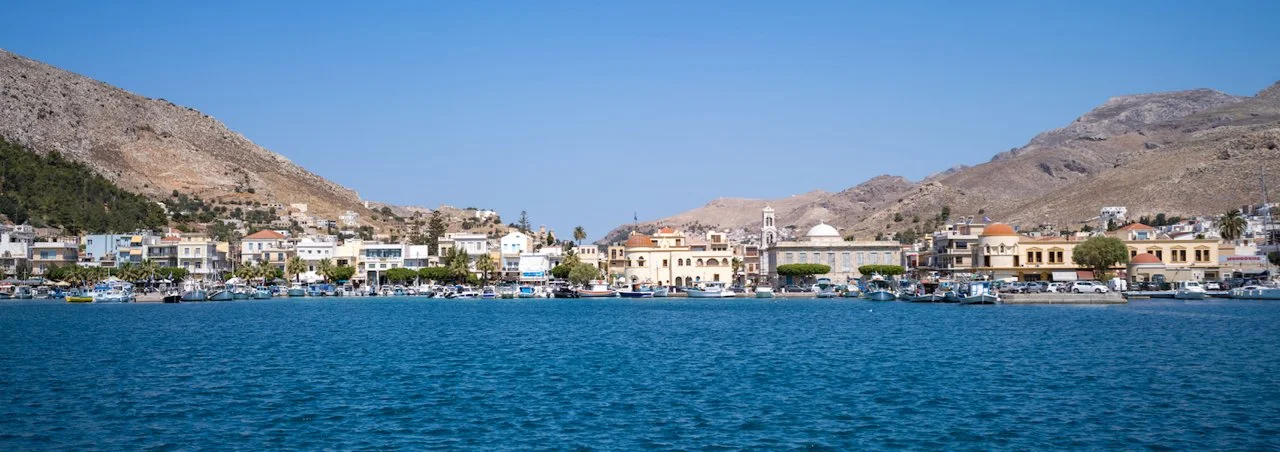
Pothia, Kalymnos, photograph John Hinde 2025
High on my list of places to find was what, in Chapter 9, Charmian describes as her favourite taverna – Anthony Skeftarios. She described a square room lying at the end of a blind alley off one of the cobbled side streets twisting away from Agios Christos (the church on the main square in Pothia). Internet research showed that this place no longer existed. Nadia told me that Fotini Pipi (who had translated Mermaid Singing into Greek) concluded that the name Skeftarios wasn’t a Greek name and she had probably meant Xefteris, which had since closed (in 2008, I believe, after being open since 1915!)
I still felt confident that I could do some research to find the likely location and what building now existed in its place. The twisting street was key to find as, once located, a blind alley off it surely still existed unless the area had been redeveloped. On arrival, I made contact with George Hatzismalis, the Municipal Tourism Officer (Nadia had suggested I speak to him). George marked a street on a map that was a popular street for tavernas (North East of the Agios Christos church, second street away from the harbourfront). Walking down the street away from the church, the first alley on the left looked like it could have been a blind alley once, as it ended in a small yard with no through access. There was a restaurant at the end of the alley and, encouragingly it looked like it had been there for decades, as well as being square and of the size that could have fitted twelve small tables, as Clift described.
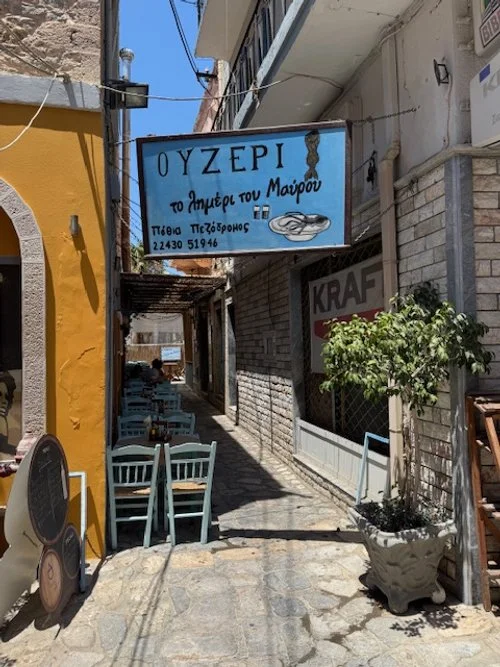
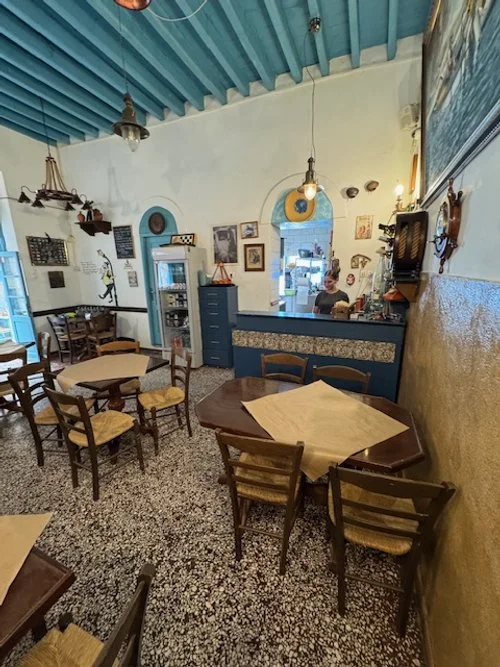
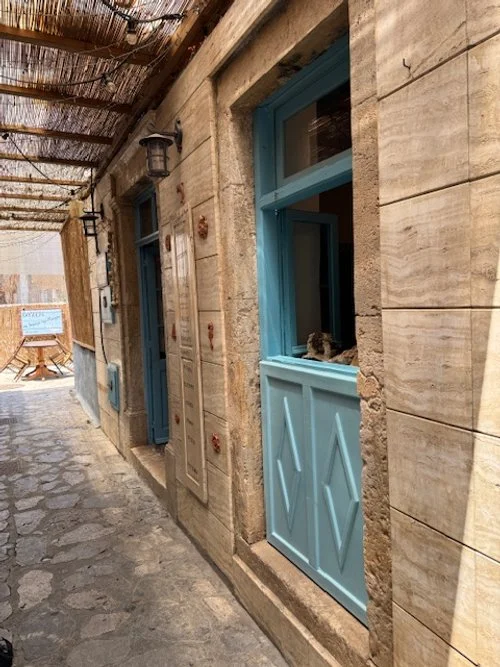

I went in and took photos, spoke to the lady there, who couldn’t tell me much, and then I continued walking down the street. I asked a seasoned shopkeeper where Xefteris once was and he waved in the direction of the alley I had come from. I went back in to the restaurant and sat down in the corner and had a beer. I imagined all the characters that Charmian had written about sitting at their various tables. I could see the kitchen – with two doors rather than windows, but that still felt broadly accurate. The floor now had tiles rather than the rickety wooden boards – but the essence of the place felt right. It is difficult to gauge just how long ago 1954 is – Elvis Presley was just recording his first single “That’s All Right” with Sun Records at the time!
When I got up to go, I noticed a scratched, and clearly very old, sheet of metal with writing on the wall. I looked closely and thought it looked like it might be the original Greek restaurant sign – a good clue and I took a photo. The next day, on the way to the main bus stop, I popped back into the Tourism Office and showed George the photos I had taken. When he saw the old sign, he was excited and pointed out that the names matched the book. We both realised that this, no doubt, was the original sign that was displayed outside the taverna in 1954.
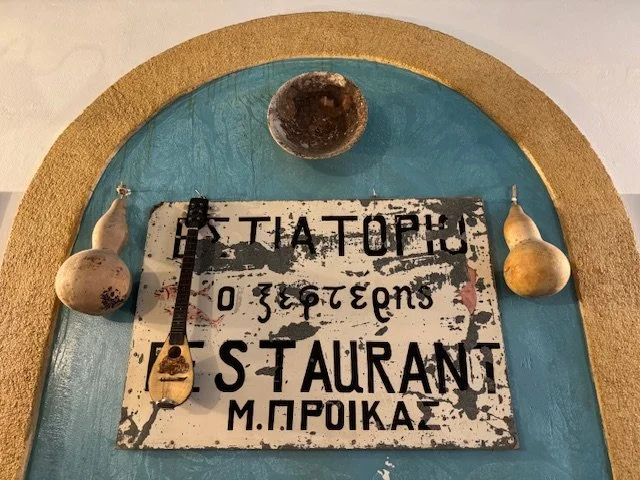
The sign!!! Second word from top is the name that Clift heard as ‘Skeftarios’. Photograph (like those above) John Hinde 2025
So, there it is – this was Charmian’s favourite taverna; the “divers’ taverna”. Here she could “eat better, drink better, think better and talk better than any place” she knew. The clues were there, mostly handed to me, and I was lucky to be able to join the dots. Like at Douskos on Hydra, you can now get closer to stepping back in time to Charmian’s world by walking from her house to Το Λημέρι του Μαύρου (as I believe it is now called) and enjoying some traditional Greek hospitality. Also, confidence in this taverna’s location helps one deduce where the other three tavernas she mentions might be; Zordos was ‘around the corner’, and there were a couple of places with arches further down the street that could be the vaulted, cavernous place she described. Alas, I couldn’t remotely find the fourth’s location as there was no mulberry tree that particularly stood out from others in terms of its size.
Happy exploring!