Kathy Kallos — Saint Nicholas Church and the Promised Land
Perched above the main town of Pothia is the imposing 19th century basilica of St Nicholas. In Mermaid Singing, Clift describes it as the ’ugly big church’, but I figured the aesthetics have likely changed over the seven decades since the Johnstons were in Kalymnos.
It’s our last day and the rain is pelting down, just as it did when we first arrived. The grey skies and drenched streets reflect the mood in reaching the end of our memorable Kalymnian sojourn. It’s time to light a candle in Charmian’s honour, to give thanks for her rich and wonderful stories which have drawn us to this remote island in the Dodecanese.
We splashed our way along the town’s western edge, with its shops, tavernas and inviting coffee houses, passing by the ‘spindly yellow house on the waterfront, with a little caste iron balcony overhanging the plateia and four staring windows’ sitting above the former sponge warehouse. I imagined the Johnstons coming out through the green wooden side door, to climb their way up through the cobbled backstreets joining the congregation at St Nicholas on Maundy Thursday in 1955.
‘The church is just as ugly within and without, but tonight the singing is magnificent. The Greek Orthodox service is primarily composed of singing -almost a primitive form oratorio using four separate singing groups: the priests, two choirs facing each other across the body of the church from high rostra and the congregation itself… the service as it progresses acquires a sombre magnificence’. ( Mermaid Singing Chapter 15)
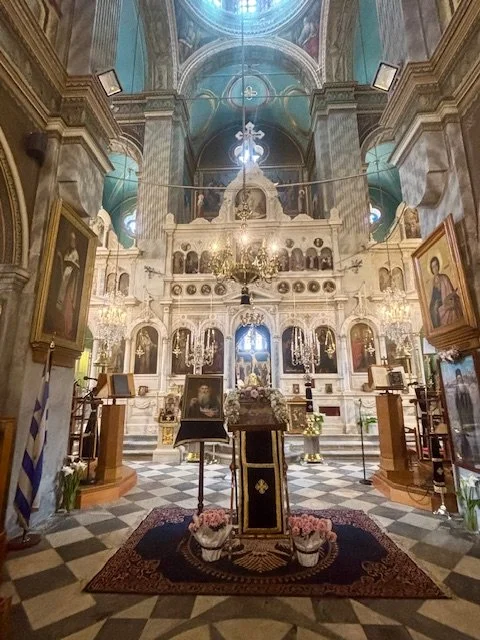
Maundy Thursday is a little more than a week away and I lament I won’t be on the island to listen to the magnificent singing, nor be part of the island’s unique Lambri festivities which includes exploding dynamite! A phenomenon we’ve already experienced, scaring the living daylights out of us the first time we heard it.
We climb our way up to the church entrance, seeking refuge from the wind and wet. With Meyali Evdomada looming, it’s cleaning day at St Nicholas. The bucket is at the ready for the black and white marble floors to be mopped and cloths hang over chairs for the dusting of icons and polishing of majestic silver candelabras .
There is chatter coming from above, on the mezzanine balcony from those cleaning. A rather large and heavy rolled up rug is balancing precariously. Before we know it, the carpet comes flying over the ledge and we duck in anticipation, seconds before it lands with an almighty thud just metres away. A close call!
Among the numerous icons adorning this grand church is St Savvas the New, the Patron Saint of Kalymnos who is holding the caique St Nicholas. It’s front and centre facing the resplendent white marble altar. A St Nicholas caique is on display outside too, in the wet courtyard overlooking the town.
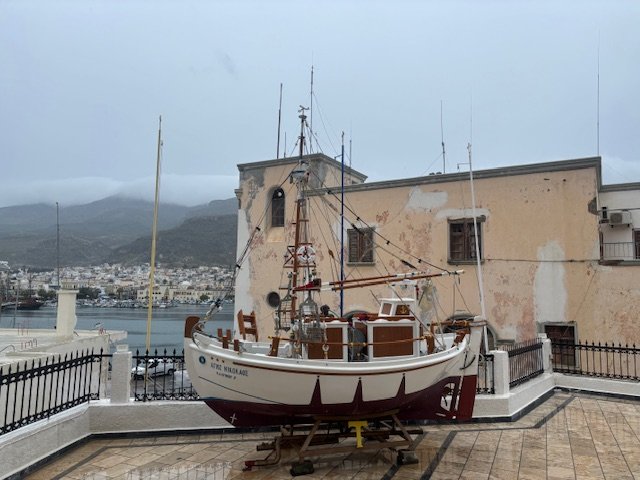
St Nicholas is the patron saint of sailors, who’d be prayed to for protection as the island’s sponge divers would set off on their annual dangerous journey. Everyone would pray for joy and the safe homecoming of their father’s, husbands, brothers and sons.
…’The bells would rock and ring a wild protestation of good faith – the divers had been most devout of the last few days, and there had been a great, many last minute, or at least eleventh-hour prayers and promises and propitiations, candles and repentances.’ (Mermaid Singing Chapter 16)
The sponge diving season traditionally started the week after Easter and lasted for several months. I imagined the atmosphere full of anticipation as the days grew closer to those last goodbyes and the overwhelming sadness endured by wives, mothers, daughters and sisters, who’d wait and pray.
‘The truth and the meaning of the little island lay here, in these men. Year after year this same scene was repeated, signalling the beginning of another unique and incredible human adventure. And year after year it passed unnoticed. ( Mermaid Singing Chapter 16)
I think of the maimed and paralysed men that Clift so vividly describes, stumbling across the waterfront directly in front of her house.
‘The crippled men never walk in pairs. That is the first thing you notice. They wrench their way alone among the streets and coffee tables by the sea or limp stubbornly between the strong.’ ( Mermaid singing Chapter 3)
In her Author’s Note to the novel Honour’s Mimic, Clift tells us ‘The book was occasioned by the actual face of a sponge diver which has haunted me for eight years’. Such was the enduring impact, witnessing the overwhelming challenges faced by the sponge divers of Kalymnos, who had no other source of income on the barren island. The fictional character of Fotis, is a failed, impoverished sponge diver with a very large family to feed. He is a social outcast in this own community and is said to have the Evil Eye on him. He, like many others wants to escape.
In Mermaid Singing, Clift tells the reader she and her husband George were often mistaken as migration officials who could arrange permits to Australia. Likewise, in Honour’s Mimic, Kathy, the middle-class Australian woman is approached by several of the island’s desperate men. She falls in love with Fotis and helps him apply for assisted passage under the ICEM (International Committee for European Migration) scheme.
The wealthy sponge merchant Demetrius explains to Kathy, his wife’s sister-in-law, the reasons why so many men are anxious for permits to leave.
‘It is a very ancient Greek tradition my dear since time began. We have always been great voyagers, emigrants, colonists. We are also now very poor people. It is natural that they should want to seek them at as great a distance as possible. The lure of the unknown. The belief in the fabulous. The golden apples of the Hesperides. Those green hills far away.’ ( Honour’s Mimic Chapter 11)
I think of those who said their last goodbyes to sail to the other side of the world on their own adventure, in search of ‘the golden apples’ and ‘those green hills’.
The synonymous parish of my youth, St Nicholas in Marrickville in Sydney’s inner west, saw the settlement of thousands upon thousands of migrants who left Greece in the aftermath of World War 2 and the Greek Civil war. The area would become recognized as the birthplace of multiculturalism; a policy introduced by Gough Whitlam’s Labor government which marked the shift from the White Australia policy and embraced cultural diversity. Only a few years ago, the local council renamed the area ‘Little Greece’ to honour the contribution made by Greek Australians.
Clift bore witness to a particular time in the history of world migration. In her essay An Exile’s Return in Sneaky Little Revolutions, she recounts the migrant ships taking young men away in ‘batches of hundreds’ as the sponge diving industry in Kalymnos was declining due to the introduction of synthetic sponges.
…’And Australia was the Promised Land then, dreamt of and wished for with such fervour, prayed for with forests of candles blazing before indistinct ikons in dim old churches...’
My own father came to the Promised Land in the early 50’s and was among the very first batch of 66 young Greek lads to be accepted under the ICEM scheme. His voyage signalled the beginning of mass migration to Australia. He was a 27-year-old single man, who’d been working the land in his mountainous village in the Peloponnese. Despite his love of learning, his poverty-stricken parents had been unable to afford his education beyond primary school. And after a penniless year of dead-end jobs in Athens, he made the decision to leave.
Australia was experiencing an economic boom offering migrants good employment prospects and political stability to raise their families.
During an oral history interview for a project documenting the lives of Sydney Greeks, Kalymnian migrant Skevos Tsoukalas told me he arrived in Australia in 1964, after being sponsored by family. He joined his five brothers who’d left nine years earlier in search of a better life. Like many Kalymnians , he ended up in the building industry and joined hundreds of Greek men on the construction site of the Sydney Opera House.
‘ Kalymnians are risk takers,’ he told me proudly.
‘Just like the sponge divers who went down to the depths of the ocean, we went up high and worked in dangerous conditions,’ he said.
Skevos would go on to become a maintenance worker using the cleaning techniques his grandmother taught him on Kalymnos. With the ensuing fifty years of dedicated service under his belt, he was lauded as one of the iconic building’s longest serving employees and given the privilege upon his retirement of signing the official ‘Opera House Book’ alongside dignitaries Queen Elizabeth II and Prince Phillip.
Others however, like the elderly gentleman I met on the picturesque island of Telendos, just off the coast from Kalymnos, made the decision to return to his homeland after spending time in Australia.
“My wife want to come back,’ he told me.
‘ Quiet life, small island, but good’
‘ In Sydney, I work hard, good money, but not easy,’ he said.
The man worked on the construction of Australia Square in the ‘60s but was compelled to quit due to his fear of heights upon reaching the 22nd floor. Keen to share his story further with a captive audience, I told him I needed to get on the boat to return to Myrties with my group.
‘ Which boat?’ he asked.
‘ I speak to the captain’ he said reassuringly in an effort to prolong our conversation.
Elsewhere in Pothia town, I encountered an elderly woman standing on the steps of her small house absorbing the morning rays. She told me she’d wished she’d never left Sydney.
‘I make good money in the factory’ she said.
‘ I buy two houses, in Redfern and Kensington, near the horses. My husband very sick, he want to come back , die on his island.’
The lady went on to explain how she raised two young daughters on her own after her husband’s death. She’d given them prika (dowry), a house each. Tears welling in her eyes as told me of her daughter’s death from cancer and being left penniless.
‘My grandchildren are good, they help me, the little monastery pays the rent ’
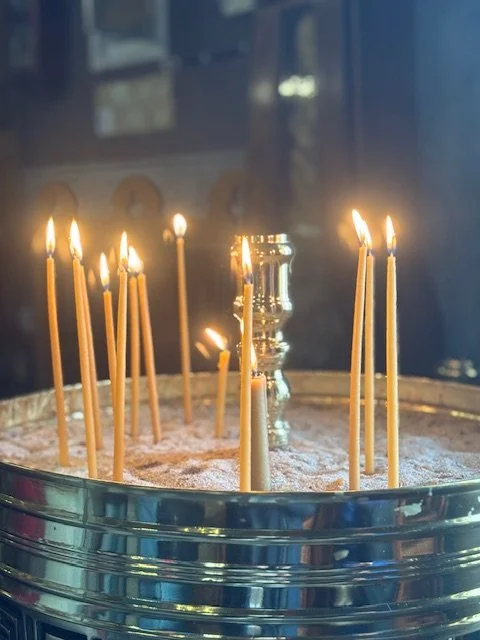
St Nicholas church is the final destination on our travel itinerary. It is fitting for it to end here, where I light a candle for my late father in the synonymous parish of his adopted country. His spiritual homecoming to the beloved country of his birth represented in the burning candle flame.
As I prepare to leave this charming, traditional Greek island which retains its soul unlike other tourist trodden trails, I once again look up to the imposing salt and pepper mountains flanking the main town, as if it were a giant amphitheatre. The Greek flags painted onto the hillsides on either side overlook the gleaming Aegean as symbols of pride and resilience of the people on this ancient land.
I reflect on CHARMIAN CLIFT’S KALYMNOS as it was then and as it is now. The very rock itself which was unable to provide for its people in the past, is now among the major drawcards to this remote island, which has become a world-class rock-climbing destination.
What remains unchanged, is the spirit of the Greek people, the culture and the power of their stories as a source of inspiration; from ancient tales of heroes and Gods to the modern narratives of the Greek diaspora.
They are stories of pain and suffering, but also of beauty, hope, and resilience. They are held in every breath and run deep in our veins. Stories that are woven through the fabric of our shared humanity, traversing continents and transcending generations.
And sometimes making their way back to the very beginning.