Christine Bayly — Travels with Charmian
1964-5
We had Charmian Clift to thank for the Christmas decorations. Her memoirs about Greek island life had been part of my mother’s reading in preparation for our family’s nine months in Athens in the mid-1960s. Christmas would arrive a few weeks after we did, missing its usual crescendo of extended family celebratory chaos. Mum wasn’t confident about finding time and materials to make our own decorations as Charmian’s family had, so she packed them, along with Grandma’s Christmas fruit cake, as insurance against too great a sense of yuletide deprivation in her brood of four children aged from three to nine, as we adjusted to life in a foreign country.
Having now read much of Clift’s writing myself, I am sure that as well as guiding the packing lists, her accounts of family life in Greece contributed to my parents’ realistic expectations of our time in Athens, where my father was working while on study leave from his university job in Melbourne. In a sense Charmian travelled with us then, although she and her family had left for Sydney a few months before we arrived in Athens.
We coped with our own plumbing disasters and Mum and Dad found the patience and perseverance to navigate the maze of frustrations hidden in the smallest administrative task. We were rewarded with hospitality, generosity and abundant wonders. In daily life and family outings we encountered ancient sites which enchanted me and I could see signs of the gods and myths in the land and seascapes everywhere.
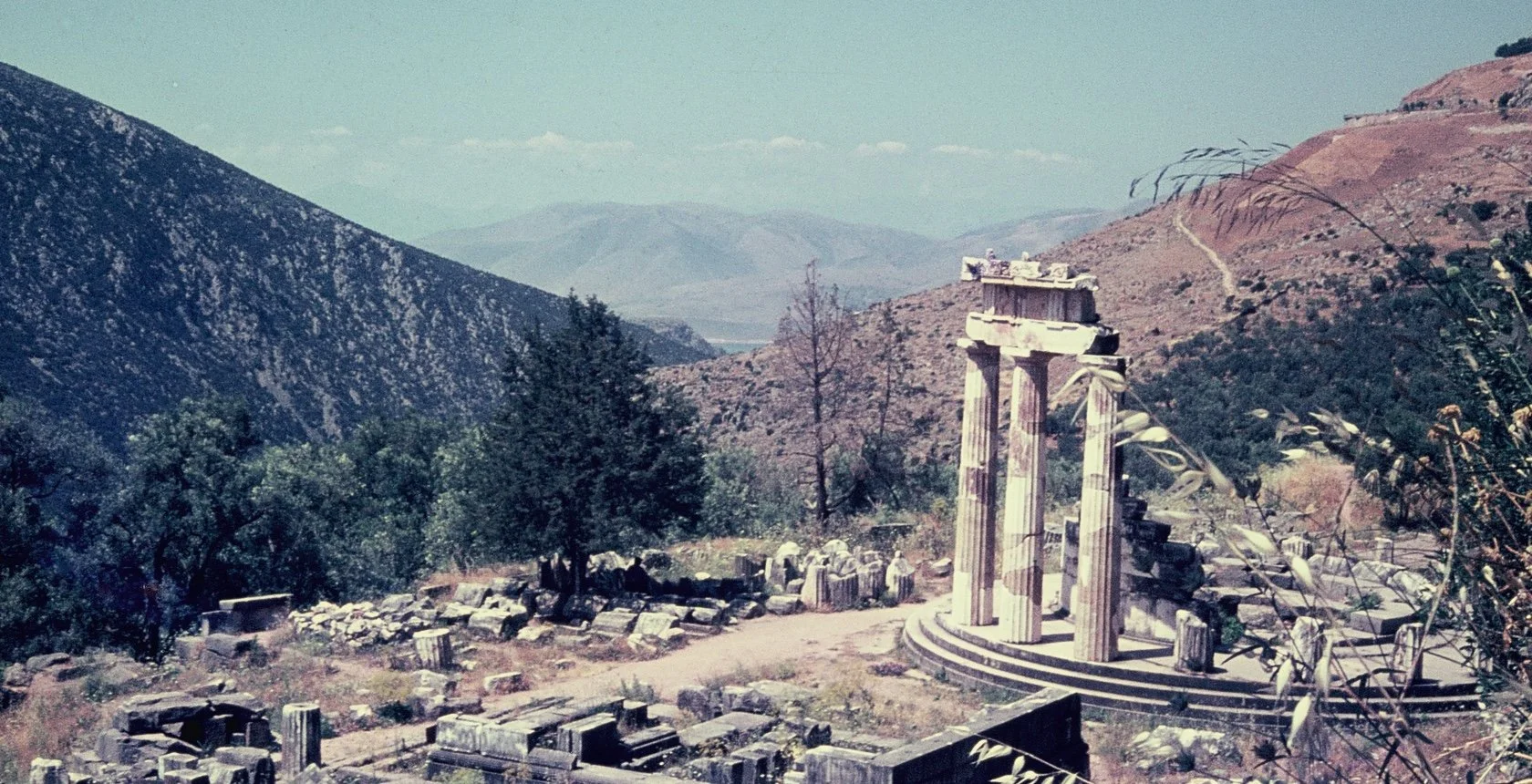
Delphi 1965: past the Tholos towards the sea
Kalymnos
In May 2024 serendipity sat me in Nadia Wheatley’s session on Charmian Clift at the Sydney Writers Festival. The prospect of a guided visit to the settings of Charmian’s memoir Mermaid Singing and novel Honour’s Mimic was irresistible; from the moment it was mentioned I was on my way to Charmian Clift’s Kalymnos workshop with Nadia and her gathered Clifties. We would carry with us a diversity of affections for Greece and connections to it through personal or family history and relationships and/or our reading of Clift’s work.
We transients from Clift’s homeland were warmly welcomed by locals during our week on Kalymnos, especially George, Irini and Stathis, who helped us to navigate and discover their island and participated generously in our discussions as we explored on location our disparate and collective responses to Clift’s writing. Our hosts spoke to the authenticity of Clift’s account of Kalymnos in the recently published Greek translation of Mermaid Singing.
Our excursions to historic sites in various states of ruin, churches and monasteries, museums of archaeology, art and culture, home life, maritime history and folklore, together with the input from our local guides, Charmian’s writings and Nadia’s workshops, wove for us a richly textured mesh of stories of Kalymnian life.
Each time we stepped out of the villa the mountains stood firm behind us glowering or protective, in discourse with the sea, the climate of the day and their sister mountains across the valley, their presence and moods as inescapable as they were to Charmian and the sponge divers.
Kalymnos dished up for us some wild wintry weather and some gentler days: we saw the mountains in all the harshness and beauty Clift portrayed, torrents running down the main street of Pothia, dark brooding clouds, white fluffy ones and clear skies, and Charmian’s sea: opal, malachite and turquoise; wild, ruffled and slow.
Charmian’s characters, real and fictional, came to life on the island where they had lived and we understood viscerally how ‘joy and sorrow are scaled to the mountains and the wind and the eternal beat of the sea’1, and how the moods of the natural environment and the crumbling citadel drove the passions of the lovers and others.
Our writing selves absorbed the influence of place on history and culture as we contemplated writing process and practice. It was highly stimulating and is still delivering to me reflective frissons.
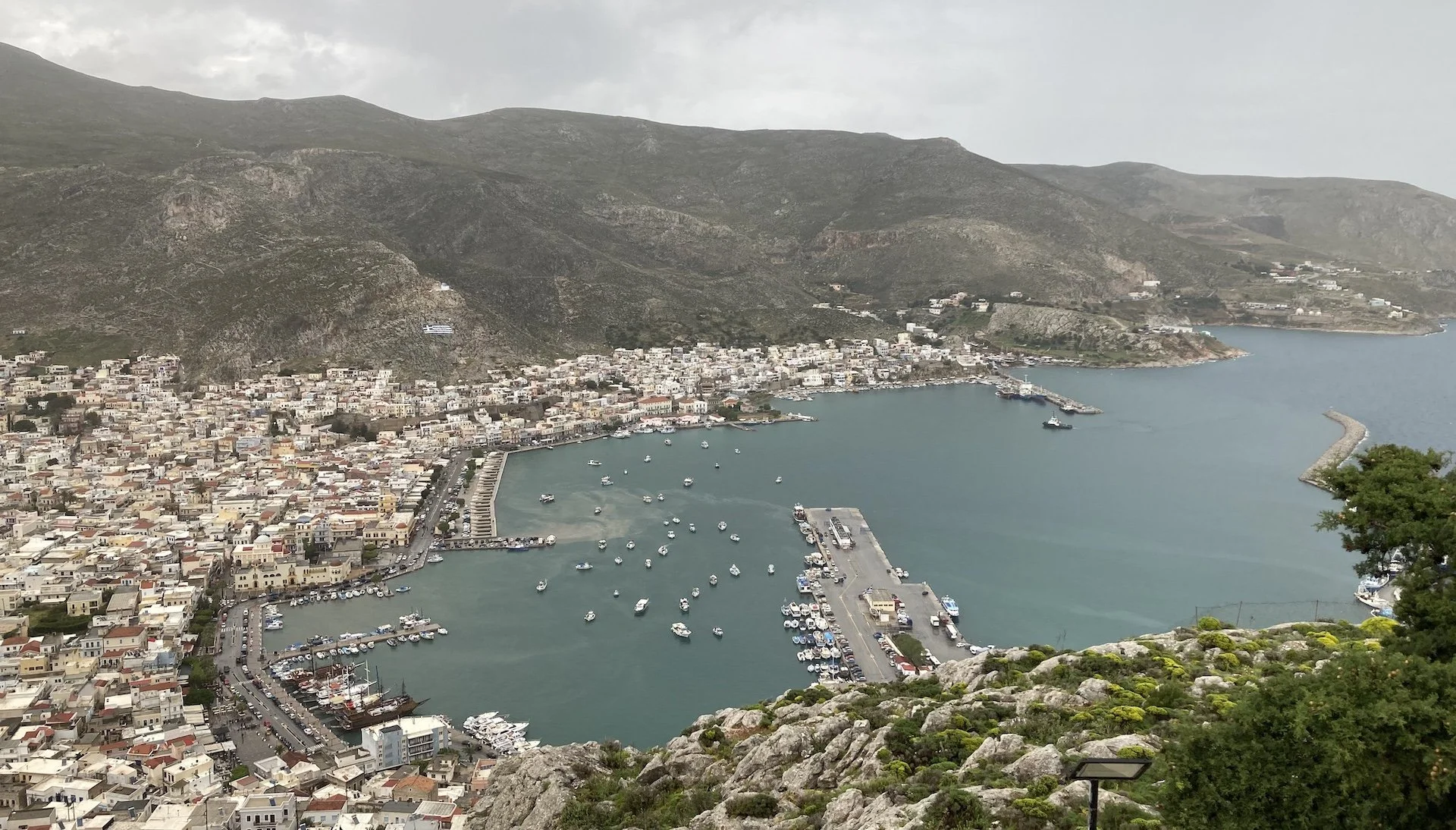
Pothia, Kalymnos
Hydra
I next met my sister on Hydra, where we had been day-trippers as children. Here it was Charmian who came to life. I could see her walking with her basket across the square from the house by the well, singing along with Leonard Cohen under a tree at Douskos taverna, swimming at Spilia and sitting with other expats at a waterfront café.
It made sense to me that sixty-nine years ago in her first spring on Hydra, having moved into the house they had bought, with a new baby, when the family’s books and small treasures had arrived from storage, ‘the mountains of Troezen are crumpled plush, and the sea rings the island in separate strands of blue like embroidery skeins’, her husband was happy and writing and they were part of a small expat community, Charmian felt ‘as though it is me who has just been born’.2
Charmian and her husband George Johnston had gone to Kalymnos with a brief to write about the local life and sponge diving; they arrived on Hydra free to pursue other projects. Here Charmian wrote again of the beauty and the harshness of the mountains and the milky and indigo moods of the sea, now writing of their influence on her own inner life and relationships and those of her often autobiographical fictional characters.
Many had warned me that Hydra had been spoiled by tourists. For a beach holiday in idyllic surroundings with no other tourists, or only a few like-minded ones, Hydra is not the place. Yes, the ferries disgorged their hordes, among whom we numbered, and yes, many of those who welcomed us to that picturesque waterfront were pushily touting goods and services, but within about fifteen minutes we could walk out of the town in any direction and find considerable beauty and a distinct sense of place.
There are still no cars on the island and we walked narrow winding paths among cultivated terraces and tinkling goat bells, with thyme and oregano in the air and wildflowers on the stony hillsides. As on Kalymnos, even had we wanted to, we could not have escaped sightlines to the sea and mountains.
Within the town I did overhear “there’s nothing to do here” and in the Historical Archives Museum “where’s the Stradivarius?”, which battered old instrument may have had a good story, but was to me less compelling than the items addressing the island’s maritime, sponge-diving and independence history. These were supplemented by exhibitions in two mansion museums telling naval and political tales, illustrating the lifestyle of the wealthy and powerful, and in the simpler family home and studio of late artist Panagiotis Tetsis.
That’s a lot of museums for a small and not very populous island: the proudly displayed historical strands entwine with the soul of mountains and sea in Hydra’s personality, which remains attractive and vigorous enough to outweigh the irritation of the tourist invasions for those artistic Greeks and expats who still live there after decades. And for me.
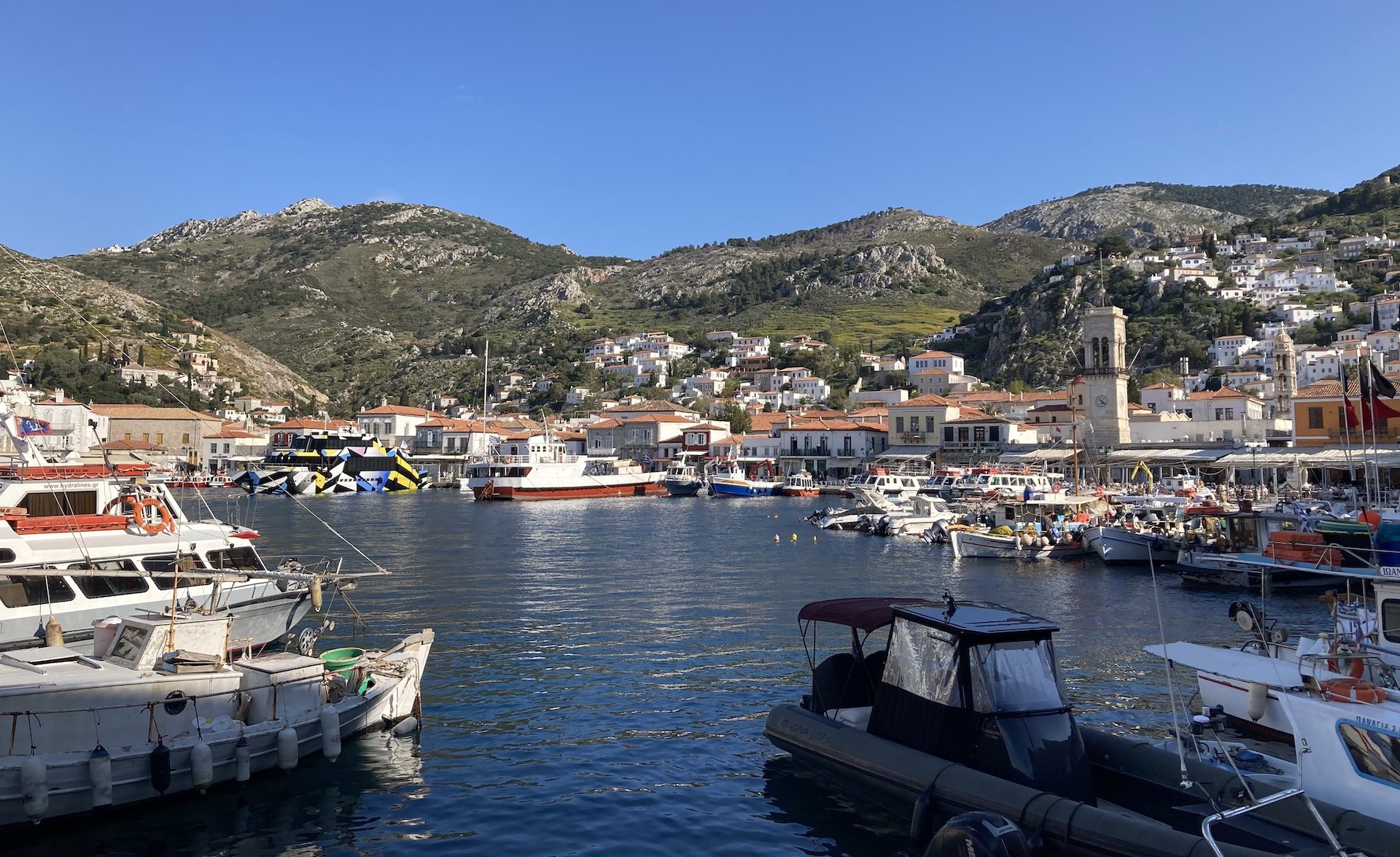
Hydra waterfront
Athens
After Hydra my sister and I spent a week in Athens delighting in old haunts and new. Back in 1965 our father called the realities of day-to-day life in Athens ‘beloved confusion’ and declared that when we departed we had left a little of our hearts behind. This was true for me although thankfully the fragments were not embalmed in a silver urn like the heart of the independence hero Andreas Miaoulis in the museum on Hydra.
Yes, some of the more recent development around Athens and on some of the islands suggests that the gods have vomited undigested Lego bricks across the plains and valleys, to lap at and ooze up the foothills. But those mountains are still there: they still look over the sea and reflect the moods of the sky and surely the gods. The sea switches between astonishing hues of blue and aqua, making its wine-dark moments more remarkable, and the monuments of the ancients still stand and lie in place.
I lit a candle there for the past and the future, thinking of Athens, Greece, family and Charmian.
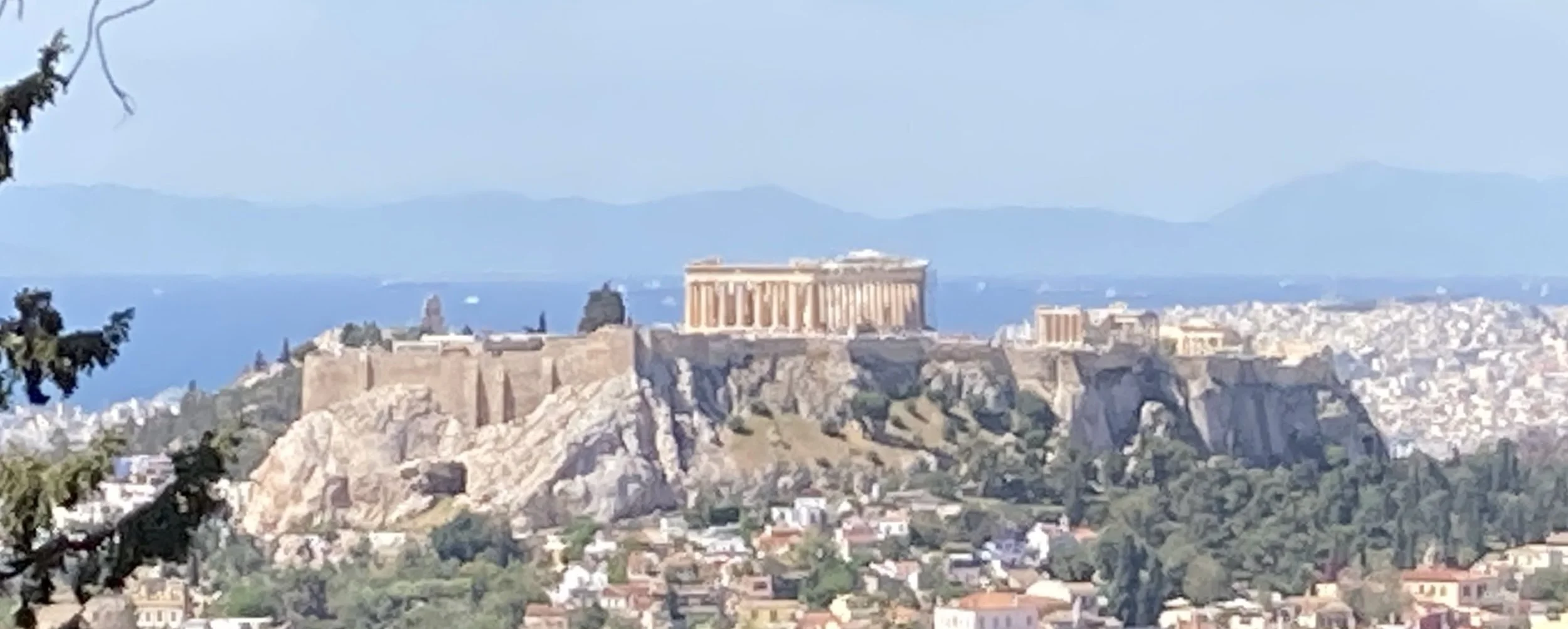
Acropolis, sea and mountains from Mt Lykabettus
Melbourne
Not until I culled my photos back home did I consciously register that on every one of my twenty-six days in Greece I saw at least two of my beloved trifecta of stony hillsides, sea and ancient relics. On the islands, sea and mountains were daily ubiquitous; in Athens on one or perhaps two days I didn’t glimpse the sea but the ancients were visibly present and I knew they and the mountains could see the water. I still see the gods and myths I encountered as a ten-year-old and am entranced now as I was then.
In his 1963 Nobel Prize Lecture, the poet Giorgos Seferis spoke of a Greek collective soul expressed in language imprinted by shared emotional experience: ‘we have always lived in the same country and have seen the same mountains slope into the sea’3. Even with only a few words of the language, I feel that I can peek into and understand that soul at least a little, aided and affirmed by Charmian’s depictions. Those mountains and their sea move me too, along with the marks of the Minoans, the Mycenaeans and other ancients.
Perhaps all along Greece has been my Ithaca and Athena, goddess and city, my guide, appearing at times, not as Mentor, as she did to Telemachus in Homer’s Odyssey, but to me as Charmian Clift.
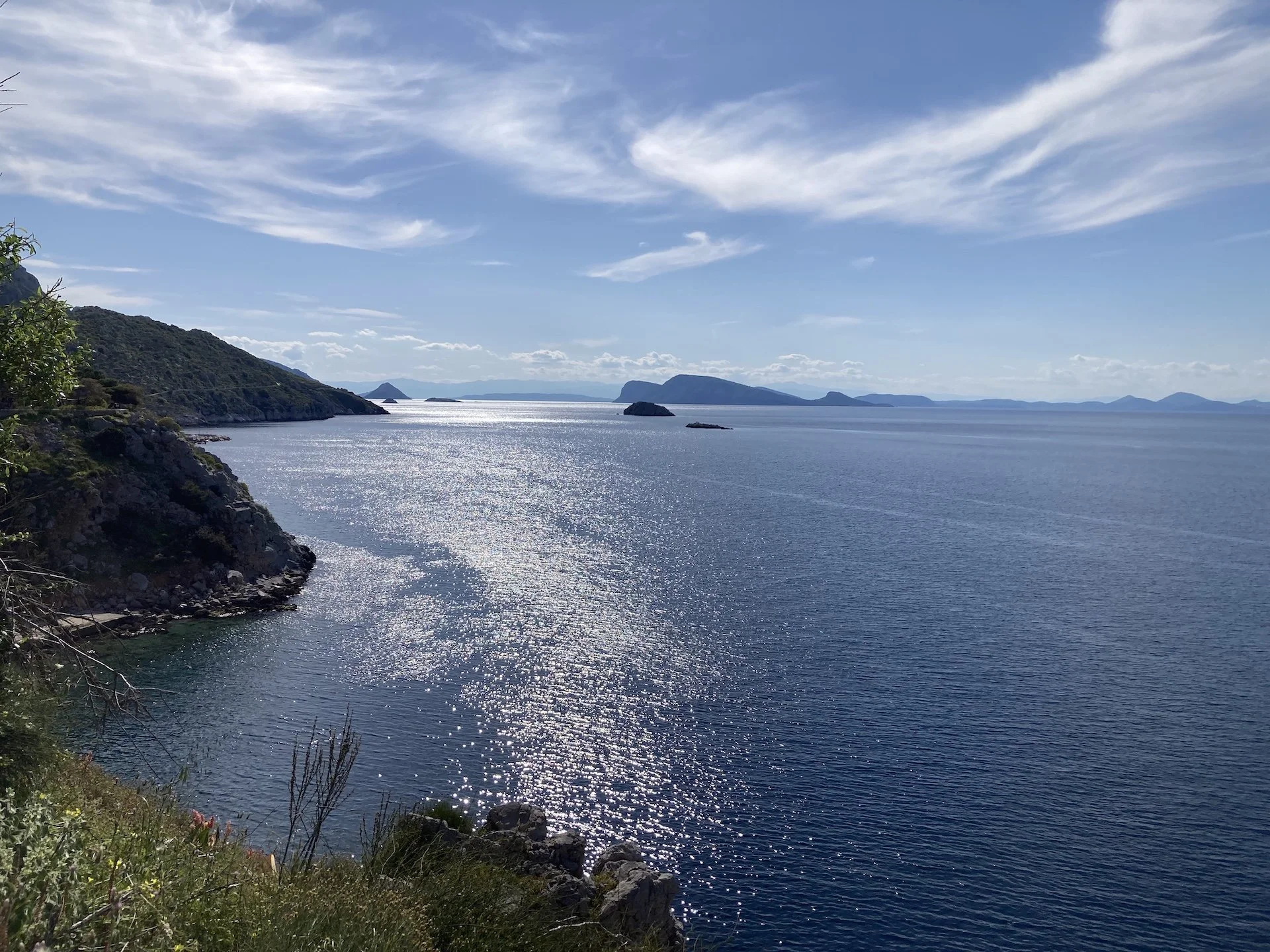
View from Hydra coast
Notes:
1 Charmian Clift: Mermaid singing (chapter 18)
2 Charmian Clift: Peel me a lotus (April)
3 Giorgos Seferis: Nobel Lecture <https://www.nobelprize.org/prizes/literature/1963/seferis/lecture/>