Janey Runci — Room Four at the Museum: a very subjective guide to the archaeological museum in Pothia on Kalymnos
Approaching the museum
You travel to the wide port of Pothia on the island of Kalymnos, perhaps by ferry from Kos, eager at the prow, revelling in the wind in your face, the slapping of the water on the side of the boat.
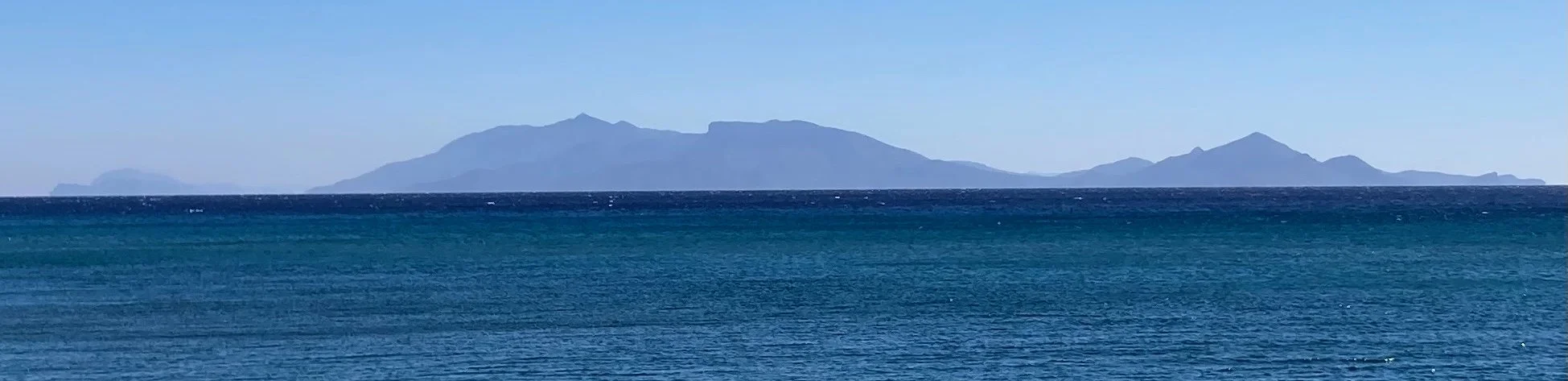
You are looking for the archaeological museum that a friend has told you is the best small museum they’ve ever visited, a human-sized museum.
You labour your way up the steep winding streets from the waterfront. Just follow the brown signs – Archaeological Museum – with an arrow to direct you. Never mind that sometimes they’re hardly visible beneath the swags of red bougainvillea, step forward and peer under the stiff greenery, find the arrow.
Up ahead, past the houses the rocky mountain rises, but do not fear, you will arrive before you come to that.
Now a long stone wall curves along the road beside you and inside, in extensive grounds is a large and faded yellow building, shabby now, but with the air of having once been a grand mansion, and indeed it has, the home of Nikolaos Vouvalis, who lived from 1859 to 1918 and was the most prominent and wealthiest sea sponge merchant in the world. By some he is seen as a generous benefactor, provider of schools and a hospitals and employment, but that employment rendered a good portion of the male population crippled, infirm, disabled – whatever word you prefer to use. There is no turning way from the dragging feet, the limping, the wheelchairs for the rest of their lives, if they were lucky enough to survive rather than die at sea and be buried on a remote island.
The incongruously modern gates are locked. The mansion which is now a museum is in disrepair. It has been closed for two years.
But right beside the old mansion is the archaeological museum.
At the Archaelogical Museum
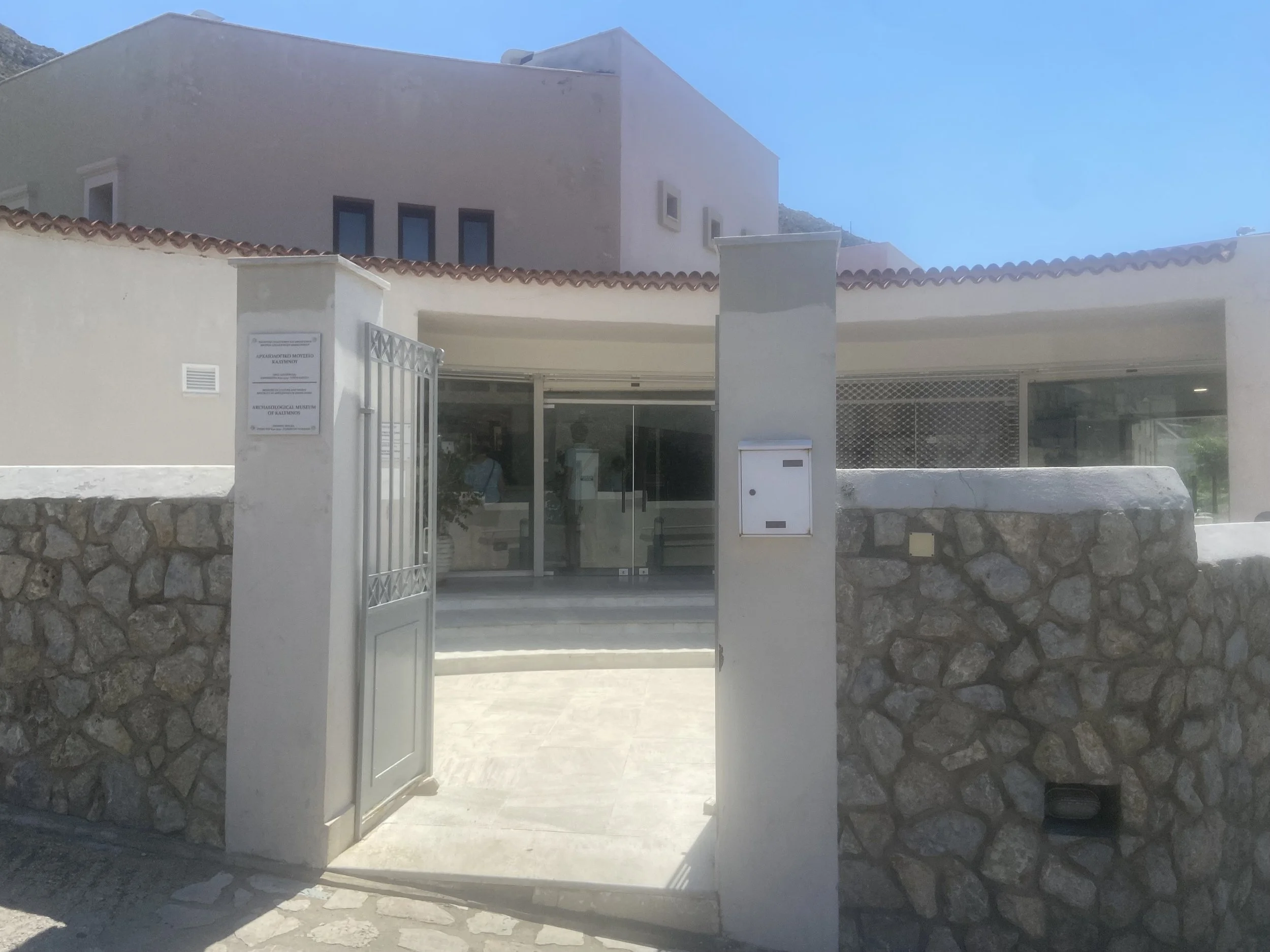
You step from the street through a modest entrance in the wall and you are at a comparatively small but wide and modern looking building with a few broad steps leading up to glass doors. The doors open into the kind of air-conditioned comfort you would find in any museum you might have visited, anywhere in the world.
But you are not anywhere. You are on Kalymnos.
Room One
Our small group is greeted by a young man behind the reception desk and our tour begins.
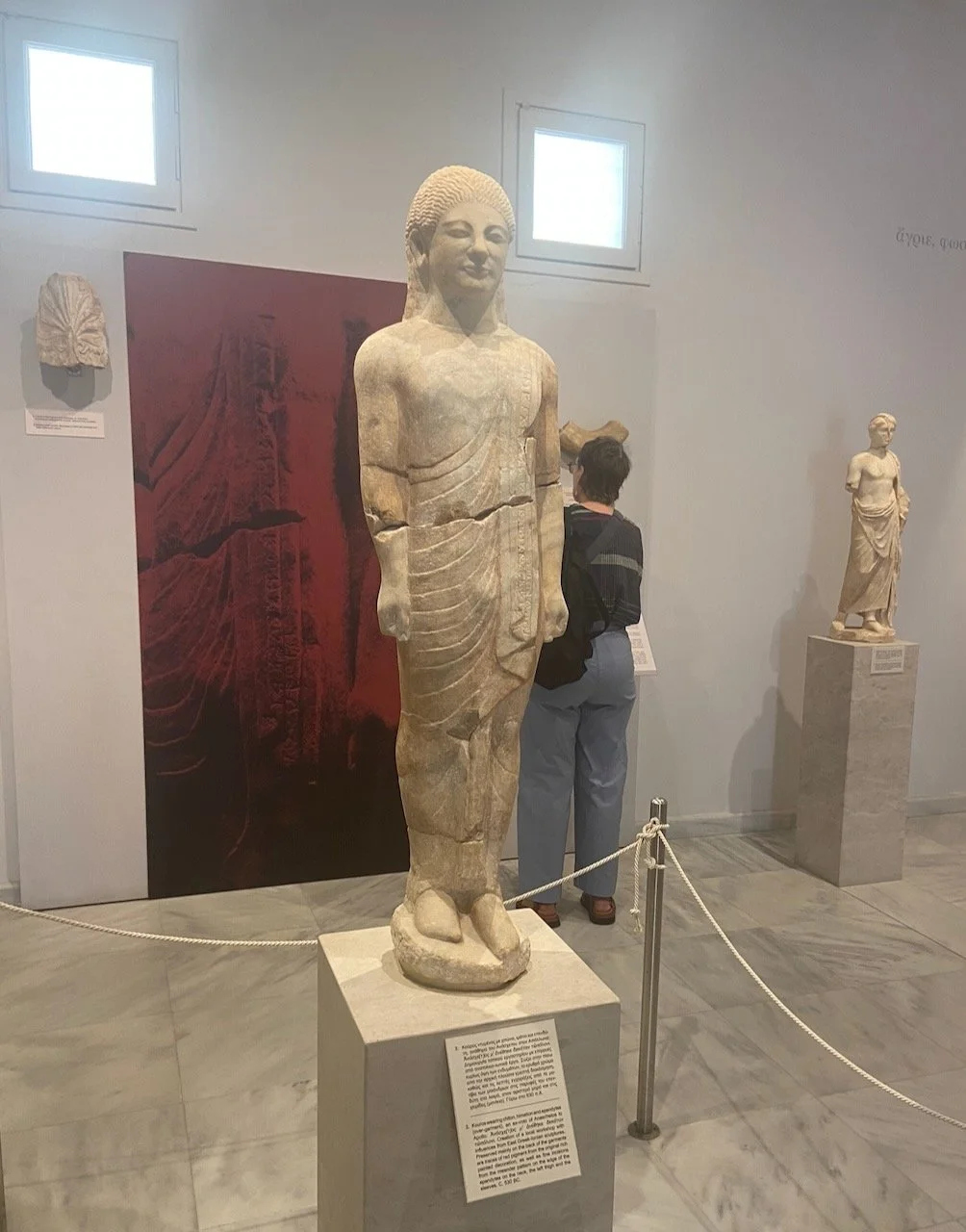
First, from the entrance, turn left, follow the guide, and make the slow passage through the exquisitely humble domestic and fighting and trading objects of the Neolithic and Bronze Ages on display, leading inevitably it seems by the arrow shape of the room to the centrally placed and clearly prized kouros – the young male figure of the Archaic period, his arms held stiffly by his side, his fists clenched tightly, one foot slightly forward.
Two men are leading us on this visit. One is the young guide who seems to be in some position of authority in the museum, at least as far as I can tell from the deferential smiles and nods bestowed by the young female workers, who stand, one in each room at the side, perhaps for security? The other man is our tour guide. Both men are Kalymnian but our tour guide is older, is familiar to us, speaks English. He is our interpreter. He apologises often for his translations, but we know enough of him to know that this is a sign of the calibre of the man – his modesty, his care with whatever he undertakes. We call him George. He does not mind that we Australians call him by this Anglicized version of the beautiful name of Georgios.
The young guide from the museum gestures to the kouros. George watches his face and listens intently. The young guide is speaking almost reverentially.
George turns to us. ‘530 BC,’ he says,
The young guide watches our faces and we respond with suitable gasps. I dutifully jot the date into my notebook.
‘Note the finely detailed draped clothing,’ George says. ‘This is unusual.’
More jotting.
‘And the letters engraved on the bronze.’
The letters run lengthways down the himation, the cloak covering chest of the kouros and are apparently the name of the sculptor. I am so busy peering and jotting that I miss the next words of the guide and suddenly we have made our first turn right.
Room Two
Although we are not strictly in another room, we are clearly entering a different space. The ceiling seems higher, the lights brighter in this room. Before us, as if in a church, a pantheon of male gods in white marble, a row of smaller ones down each side, each perfect male body, the hip seductively cocked, gazing it seems with a slightly amused contempt at this group of elderly female visitors from the 21st century whose eyes are unwillingly drawn to the immense and swaggering male figure, hand on hip, exuding self-satisfaction from his central place at the end, as if on an altar.
We stare, the guide beams. He gestures to the first smaller figure at the side and speaks.
‘The god, Apollo,’ George translates. ‘Note the lyre, and on this next one, the bow.’
We are directed to study the characteristics of each of these smaller gods. Some of them are headless, but it is clearly the bodies below that matter. What I am noticing as we make our way down the space, like a group of acolytes following the priests, is the way the lights are placed to highlight the figures, backgrounded by shadows in this perfectly kept room. Perhaps our earnest young guide had a say in the curating of this space. Although I cannot understand what he says I can see his pride in the display. This pride culminates in his expansive open-armed gesture to the final god who has dominated the room from our first sight.
‘Asklepios!’ he says.
As I gaze at the statue I am disturbingly reminded of the word cannonato and of the Italian woman who admiringly used the word many years ago to describe my Italian husband of the time. I was puzzled. I thought the word meant a gun shot, that cannonade meant a single loud blast from a canon and I was right. The woman nodded. That was the perfect word for him, she said. I did think briefly that it might have been a sexual allusion, but her serious kindly face persuaded me otherwise.
But this statue of Asklepios – cannonata indeed.
We are told that Asklepios is the son of Apollo and he is the god of healing as indicated by the snake entwined staff, still used as a symbol of medicine today. I stare and stare. I find it almost impossible to associate this figure with healing. I also find it absurdly satisfyingly that in the passage of vicissitude and time this huge statue has become truncated. Only the upper half rests on the stand, the clothing draped down from one side. The disconnected sandalled right foot is propped in position on the floor underneath. The left foot (along with the remainder of the snake and staff) is artfully positioned on its own stand at the side.
I am privately pleased that the male organs are gone. Later I will be glad to learn that Zeus was obliged to kill Asklepios with a thunderbolt when this god of healing became so skilled at medicine that he brought the dead back to life. By this means Zeus restored the natural order.
At last we turn right at Asklepios.
Room Three
The room has similar dimensions to the one it opens from, but it seems more muted, the lighting less dramatic. There are some smaller statues on the sides and at the end only a lintel high on the wall and large boards of explanatory text below. At least it is a relief from the Pantheon room.
And now, as I take a deep restorative breath I see beside me what I have been looking for, a statue of a small boy holding a ball loosely at his side, as if paused in play. His eyes are demurely down, the lips drawn up in a slight smile, a child holding a secret, the roundness of the young body cocked slightly at the hip, as if to pose as required. I jot as carefully as I can, moving around the statue. I take photos.
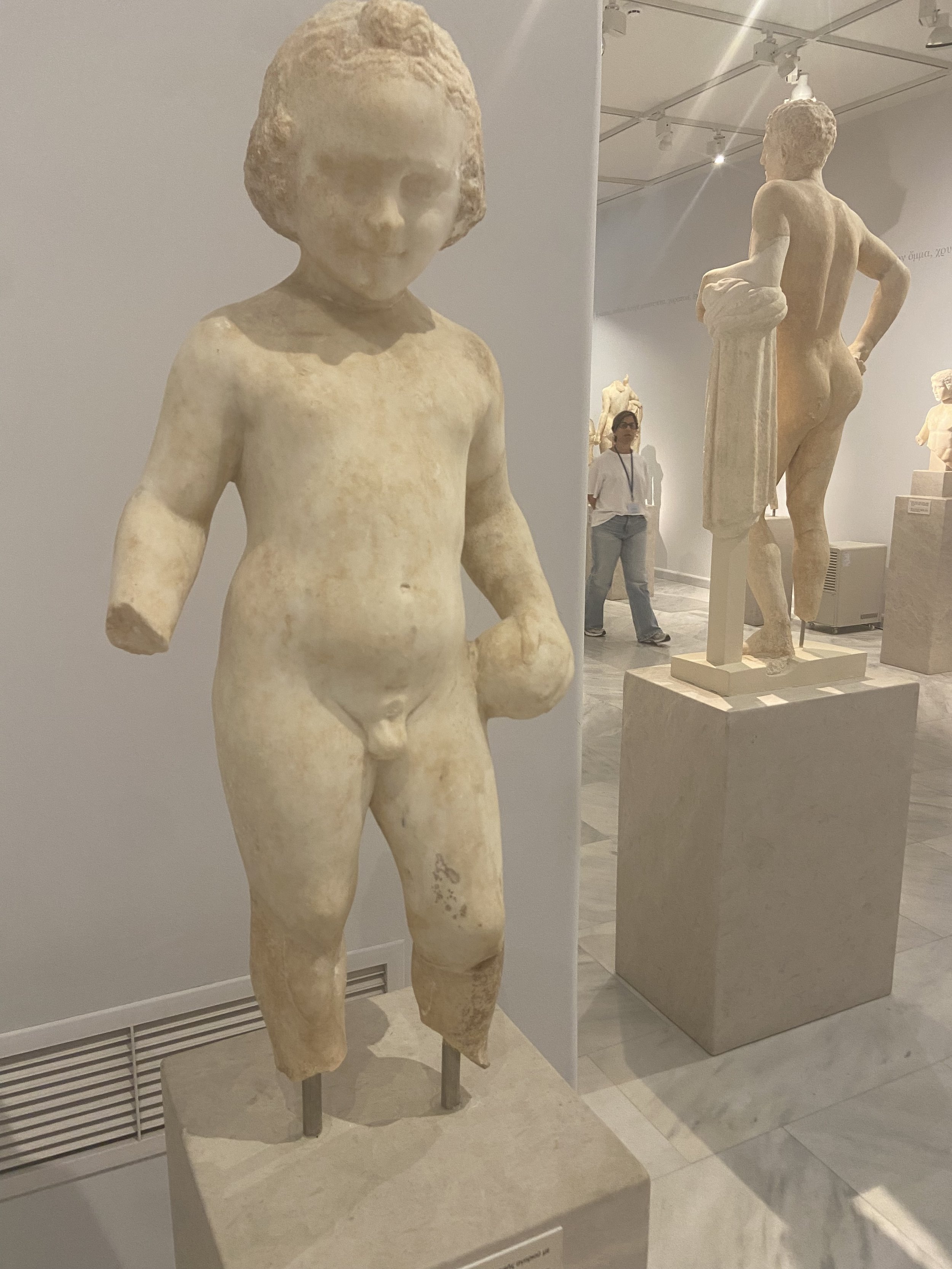
When I say I have been looking for this statue it is not because I knew about it before, but rather because I (and my companions in the group) have a task to fulfill on this visit to the museum. We have been instructed to choose an item in the museum, one we connect with, and then to stay with that piece, to be with it, and later, when we are ready, to write about it.
I am not sure if I am turning so eagerly to the boy statue in reaction to the preposterously large presence of the Asklepios statue behind me. Never mind. I can stand here, a mother, a grandmother, doting over this child with a ball. He could be part of my life, one of my grandsons so pleased that he has caught the ball I have thrown him.
Now I must hurry to the end of the room where the group has gathered. I briefly note as I pass a medium statue of a goddess, the serenity of her face and posture. I think it’s Athene, but it is not as carefully lit or displayed as the pantheon of male gods.
Our own guide, George, is eager to tell us about what seems to be the unremarkable exhibition of a marble lintel held up by two iron rods high along the back wall.
‘Notice the lettering along the lintel,’ he says. ‘This is how public announcements were made at the time.’
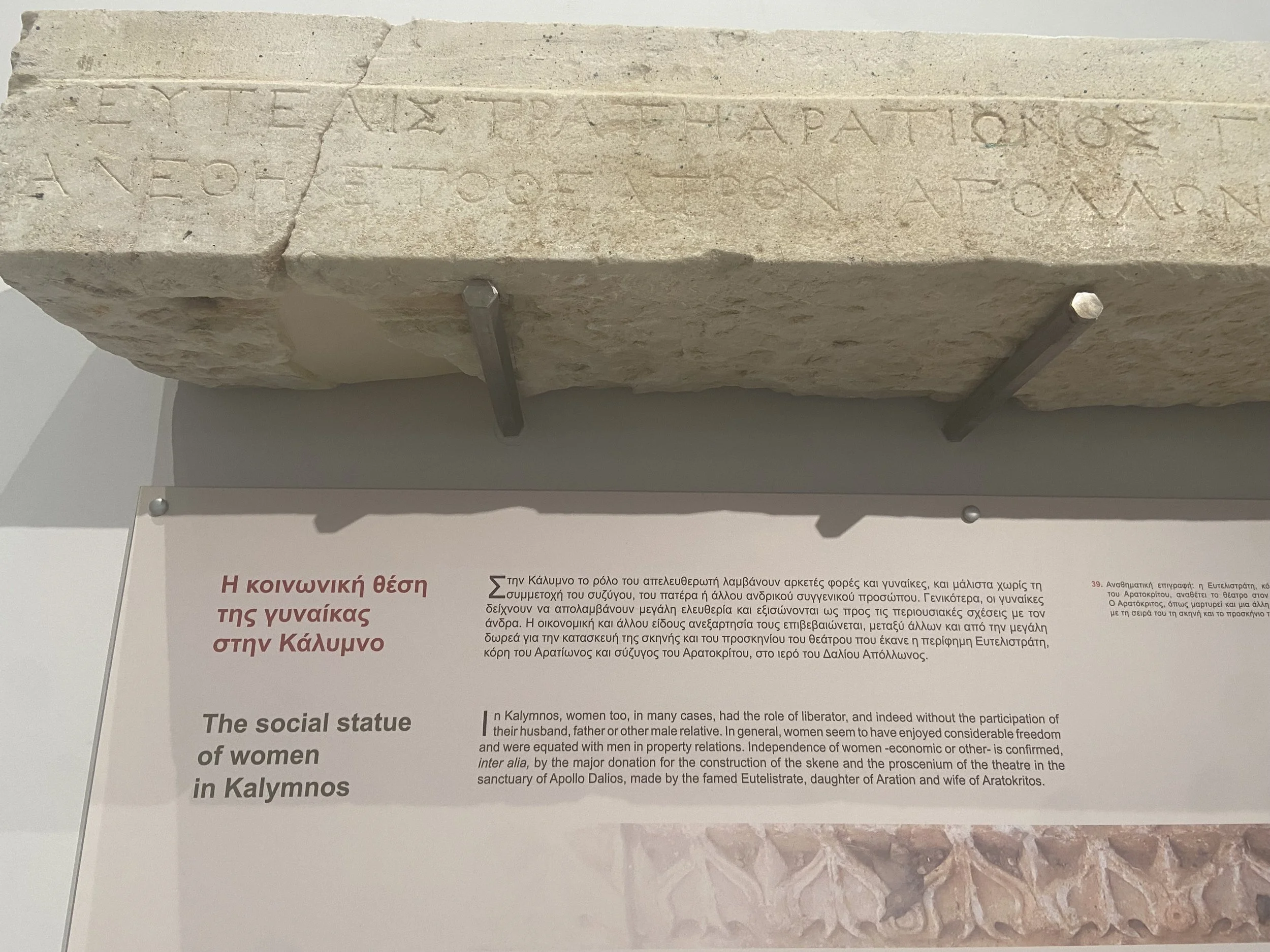
He points at the lettering and spells out the name of a woman. This is followed by the name of her father and then her husband, but still her own name is there. This woman, George tells us, was a woman of some distinction, involved in the administration of her city. Her name is there because she has donated money to build a theatre.
Clearly two of the members of our group have found the object they will write about but the Greek-speaking guide is checking his watch. He is keen to usher us out of the room, back through the Pantheon, past the Neolothic and Bronze Ages and into the foyer and through the next door.
Room Four
My first impression is of shabbiness. It is not as brightly lit as the Pantheon. It feels like some kind of storeroom.
‘Look!’ George watches our faces eagerly as we turn to the left and there she is. The Lady of Kalymnos. She is probably even taller than the Asklepios figure, but blessedly plain. No flaunting here, a huge bronze figure looming over the room, her grief-stricken eyes staring out, one hand raised towards her face, the other held by her side and wrapped in her fringed shawl.
‘Stately’ is the word that comes to me, but it is not enough. This is a figure I could see as a healer, a wise and compassionate woman.
We learn that she dates from the 4th to the 3rd century BC. She did not originally come from Kalymnos, her origin is still debated by scholars, but she is owned by the Kalyminians in a very particular way as we see in the stories that begin to flow from our two guides.
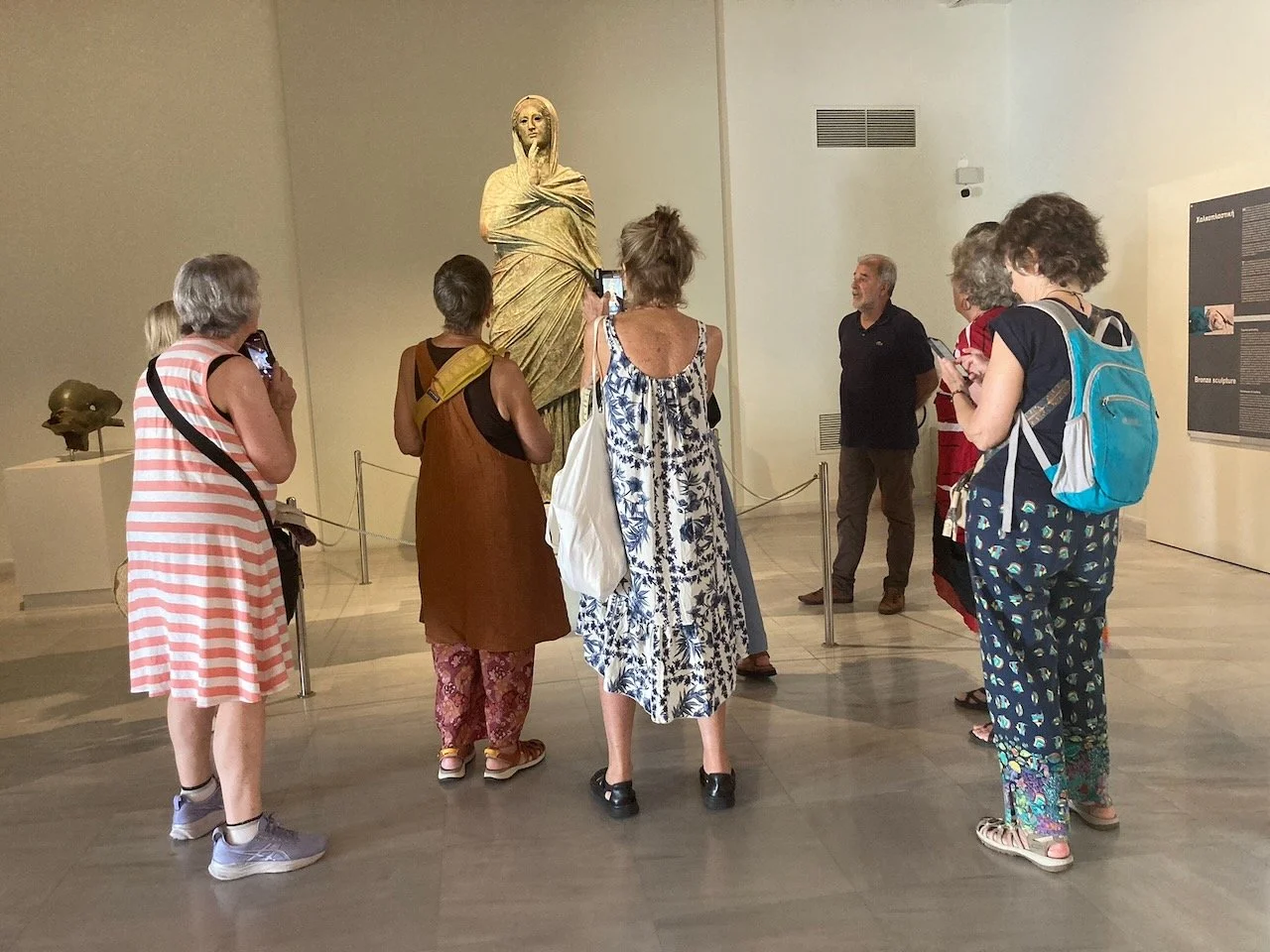
The first story is about her miraculous emergence from the Aegean Sea in a local fisherman’s net as recently as 1995. It was a Kalymnian who found her. She was taken to Athens to be restored, cleaned and stabilized and then returned to this museum on Kalymnos.
But other items have been taken and not been returned. A bit to the right of the Lady is an empty glass cabinet with a roughly copied photo of a head attached to the front and some typed notes beneath.
Head of a ruler with headband and brimmed hat, the notes say, and further down - found accidentally in 1997, in the stretch of water between Pserimos and Kalymnos. Handed in to the authorities by Mich. Koufakis.
In a further cryptic comment – It possibly belongs together with the lower limbs of the equestrian portrait statue in the showcase of the opposite side.
And sure enough there on the side there is another empty cabinet with a garishly copied photo of two dismembered legs.
George shakes his head. ‘I love the legs,’ he says. ‘Such perfect details.’
It is when I turn back to the Lady that I also notice in the corner beside her an old fire extinguisher and an even older-looking air conditioner. No wonder that I first thought of the room as a storeroom. I have an absurd desire to get a broom and give the Lady’s room a good sweep, to take the old fire extinguisher and the air conditioner and prop them beside Asklepios in the Pantheon room
George tells us that the contents of the empty cases are in Athens for care and further study. The Greek-speaking guide shakes his head mournfully. He and George are both afraid these items may not return to Kalymnos. They have stories of more hidden treasure being brought up from the sea, and the items being carefully stowed in the houses of those who found them.
George himself has an amphora in his home. His wife’s father was a diver, and he gave the amphora to them as a gift. George has been approached by a museum and asked to hand it in.
‘Will you do that?’ someone asks.
‘I won’t!’ he says fiercely. ‘My father-in-law gave it to us. He was the one who dived down and found it.’
Perhaps there is a memory of all that the islanders have suffered from the sponge diving industry, a claiming back of some of what was taken.
After the Tour
Our Greek speaking guide checks his watch again and leaves us. We each wander off to view our chosen items.
When finally we step out from the glass doors into the heat we are comparatively quiet, each in our own reverie.
I know I am changed by my visit to this modest seeming museum.
I hope you will be too.