Maureen McCarthy — Lost in Kalymnos
Three a.m and I’m trawling through every foolish thing I’ve ever said, every bad decision I’ve made, all the relationships I’ve messed up, the times I’ve unintentionally (and it has to be admitted, on occasion, intentionally) crossed or hurt someone. It’s like an intruder crept in during the night, cracked a bottle of malevolent little demons over my head and urged them on to do their worst.
Mostly I do manage to avoid the worst but when the suicidal brothers, brutal father, dead sister and missing son make an entrance, I know it’s time to get up.
So here I am, up, sitting on a rickety chair at the Villa Melina in Kalymnos drinking tea at dawn. What now?
I decide to go and get lost.
I pull on some clothes, pocket some euros, grab a note book, a water bottle, turn off the air conditioner, then push open the stiff, shabby grey shutters that lead out onto the shared balcony.
The air out here is so still, so pure it makes me want to catch it in my hands, rub it through my hair, push it between my toes. I unbutton my shirt, lift my arms to the sky, and breathe it in. From the edge of the balcony, I watch a translucent mist seep down the valley like a gift from the gods to help ease in another day. Pale gold light washes over the bare rock mountain, stripping it clean of any kind of menace. It’s a paper cut out now, stuck onto some clever child’s art work, benign and manageable. The small white warning cross is still up there of course, along with the stern presence of the ever-watchful St Savvas, but the turbulence, the wars, invasions and hunger that have beset this island for centuries have momentarily receded. The mountain sits as it always has, in silent stately indifference.
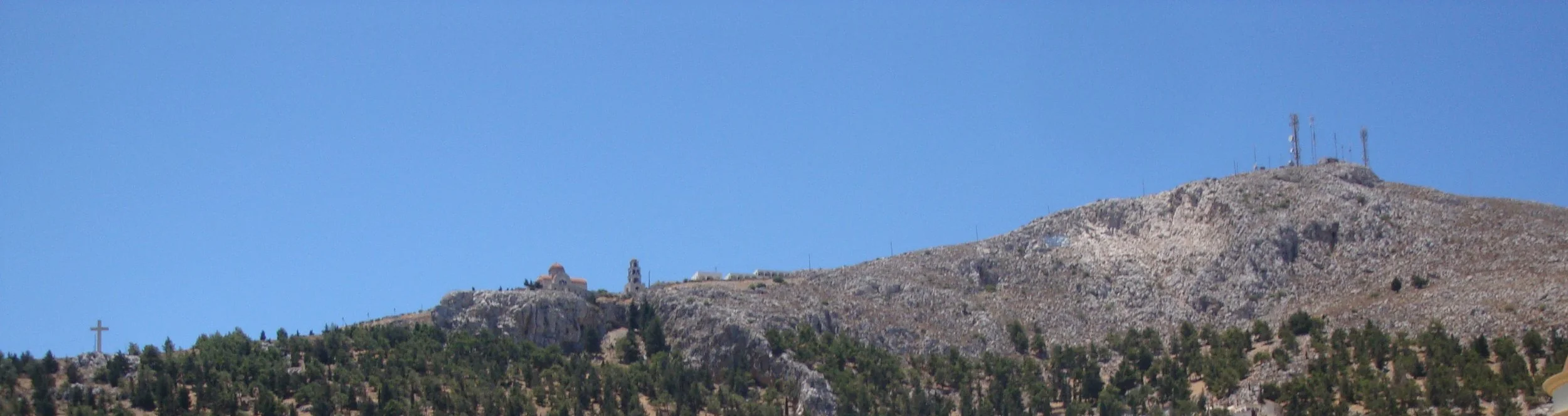
The top of the mountain on the western side of town, with the white cross (far left), and the dome of the monasery of St Savvas the New, watching over the port-town.
And so, what is there to fear?
I tiptoe down the creaky stairs, holding the banisters as befits a woman my age. Once down on the ground floor I lift the catch and walk out under the canopy of bougainvillea to the front gate leading into the street.
I am a woman alone in the world.
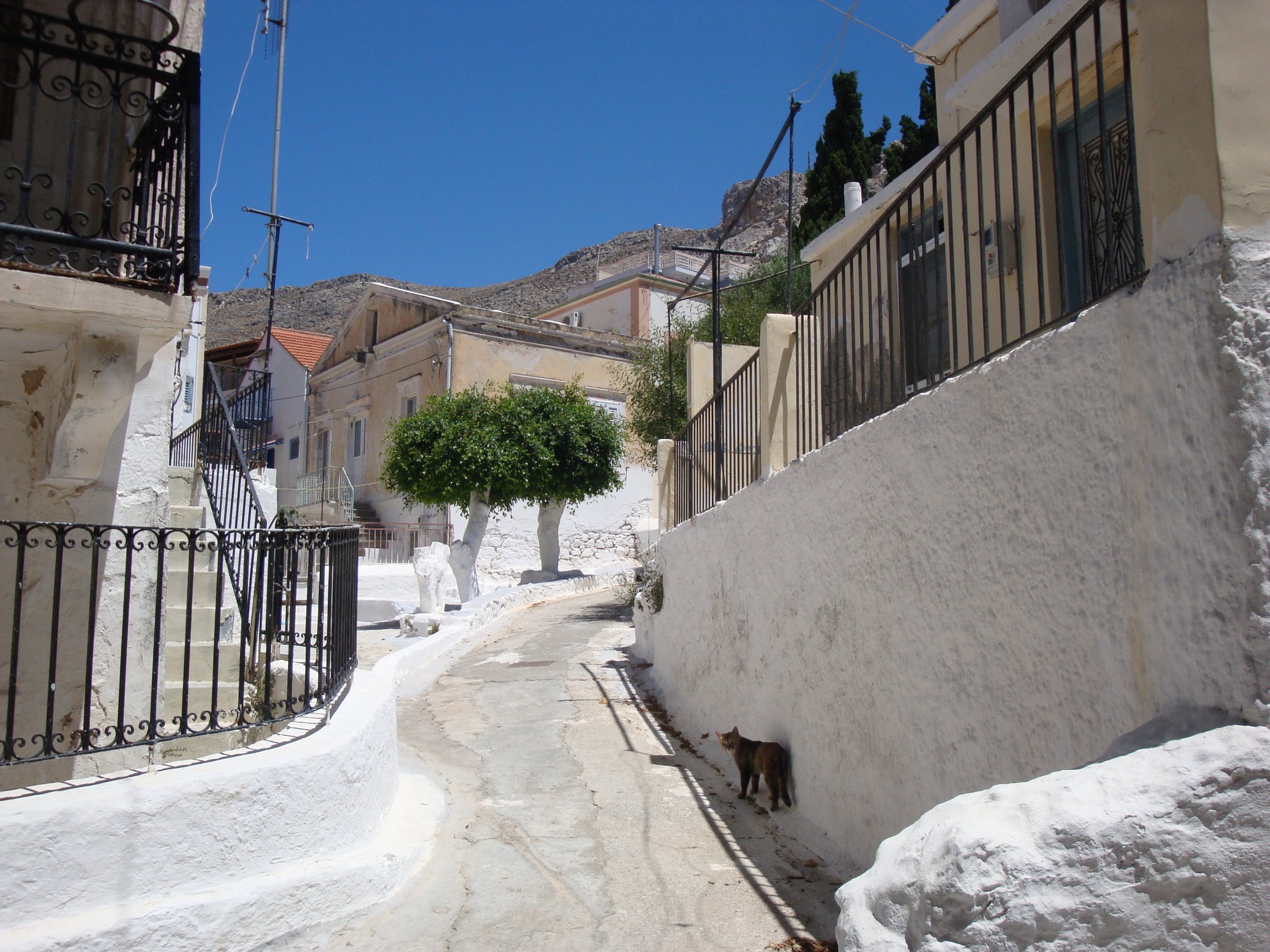
This is going to be easy. I have a bad sense of direction at the best of times and rarely take notice of where I am exactly. And I’m lazy. I don’t notice landmarks, never even try to remember directions, and I hate taking photos. I do see things though, like the pretty pots of flowers outside some of the houses, tiny morning birds as they flit past towards a tree, along with the former loveliness of a large perfectly proportioned abandoned house. Small clusters of cats lie about on the narrow footpaths. Some curled up together and other’s flat out like exhausted heroes back from war. A big black Tom opens one wary eye to watch me pass. When I stop to look at him, he rises slowly and stares straight back through narrow yellow eyes. I don’t much like his male insolence. It reminds me of some of the adolescent boys I used to teach. What did you get up to last night? I say under my breath. He yawns, stretches languidly and settles back down. A question beneath his contempt.
An old woman in black is sitting outside her front door. ‘Kali Mera’ we both smile. I move closer and see that she making some kind of skirt or dress out of deep gold fabric and is trying to get the pleats to sit correctly along a waistline. Her hands are small and brown, rough with hard work but she is nimble enough as she picks pins from a small tin on the table beside her and slips them into the thick shiny fabric. She holds a few in her mouth as well and that makes me remember trying to make clothes when I was a girl. She smooths the pinned section of the pleating over her knees and seems satisfied.
‘A party?’ I ask, pointing at the dress. But she only shrugs and smiles, not understanding, takes a needle from the tin and with those thick fingers threads it, first go. I’m impressed.
She begins to tack along the pinned lines in large white stitches.
‘For you?’ I say pointing at her work. She shakes her head and laughs. Then, ever so slowly, she heaves herself off the plastic chair, goes inside and brings out an A4 black and white photo of a young woman. Ah! for her daughter maybe. I nod and then have a moment of inspiration. ‘Yai Yai I say pointing at her. Her face breaks open into a broad smile.
‘Yes’ she says, And points to herself ‘Yai Yai’
I touch her arm briefly. ‘Your granddaughter will look beautiful’ She takes my hand in both of hers and squeezes it warmly. ‘Yes’ she says again and smiles ‘granddaughter’ pleased to have remembered the English, word just as I am to remember the Greek.
I deliberately turn down a dingy very narrow street and stop outside the mechanics shop I’d come across a few nights before but it’s locked up now. I picture the three or four men working at night under a single, swinging yellow light bulb with all that broken machinery lying around them, most of it covered in dirt and oil. Car parts, farm implements, engines and bike parts, old wheel barrows and wringers from washing machines. A cement mixer in one corner and some kind of scythe in another. The men grunting with effort as they lift a car engine up onto a bench. There is a man wearing no safety equipment welding some kind of hook onto a long piece of iron. Orange sparks fly defiantly into the air like angry wasps.
I reach the back road. Some of the shop keepers are already there. They look at me curiously as I pass but always smile and return my greeting. Kali Mera! Shutters and blinds slide up, doors open. A middle-aged man comes out to sweep the path. A whiff of coffee hits my nostrils before a couple of motor bikes roar around a nearby tight corner.
Out onto the harbour now and the mist burning off the bright water gives the scene a dreamy, almost mystical quality. The moored boats bobbing in the breeze under that dome of endless cloudless sky catch me in a tangle of stray thoughts. Children. Dogs. Night terrors. I head on down through the hundreds of empty white taverna chairs and begin to walk along the water’s edge.
An over weight fish merchant, holding a small radio with both hands, is sitting on a stool too small for him in front of empty stainless steel display cases. He sings along with the loud Greek music blasting from the radio, too absorbed to notice me when I call good morning.
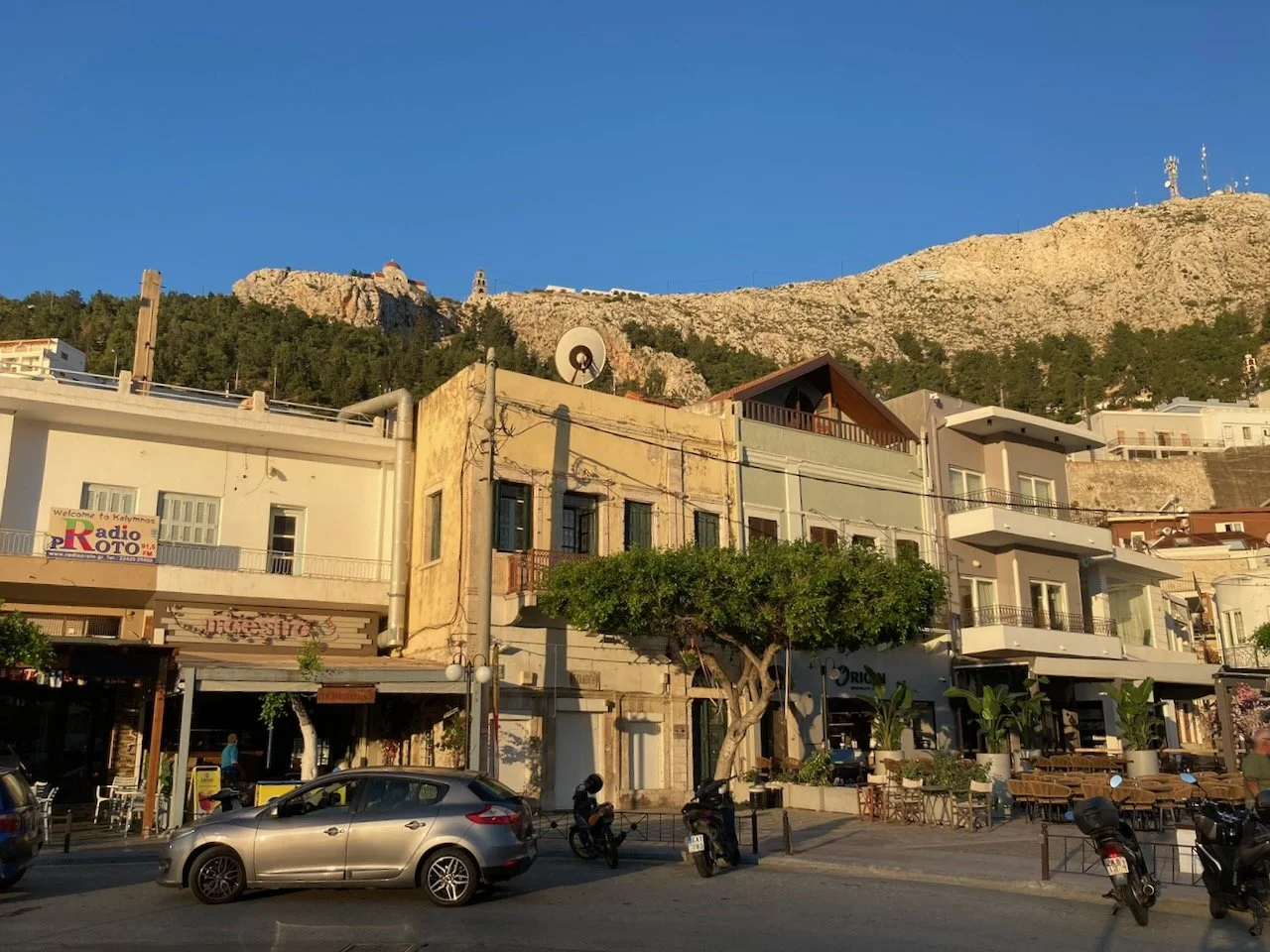
Clift’s ‘Yellow House’ by dawn light. (Can you hear the typewriters clacking?) The church of St Savvas is perched high above.
I see the Yellow House in the distance, nestled in between its neighbours on both sides and as I get nearer for a weird few moments the present fades away. The sea is once again right up near the house, a tree and boats just outside the window and the square alive with activity. Divers and fishermen with nets, women with babies and baskets of produce, kids everywhere. The Australian couple are upstairs on their clacking typewriters and the two blonde children are out playing on the boats.
One of my favourite sequences in Mermaid Singing is when Charmian Clift describes heading out to look for her ‘lost’ six-year-old daughter. Lunch is ready and she wants her home. What follows reads like a playful meander though the physical and cultural life of the village. The little girl was last seen playing five stones on Dimitri’s caique with other kids. Then someone saw her go to watch an ewe being washed. After that she walked some distance around the cliffs to the slaughter house and from there moved on to a friend’s house to check out the new baby. Clift gives no indication that she’s actually worried for the child’s safety, more mystified, wanting to solve the riddle of her whereabouts. Up and down steps, into and out of houses, her descriptions of those she meets, the houses and the harsh erratic landscape of the village, sparkle with loving detail. Eventually the little girl is found in the middle of a funeral procession heading up the mountain. A hot day, singing priests and the grubby little six-year-old Shane amidst a throng of mourners following a coffin.
‘I’ve had lunch!’ she tells her mother indignantly, then proceeds to itemise all she received from everywhere she went. Figs, tomatoes, bread and oil. And lastly, of all things, a baby kitten which her mother insists must be given back to its mother if it is to live.
I lost my ten-year-old son once for few hours in safe suburban Melbourne in the early eighties and I called the police! They were kind but, much to my irritation at the time, didn’t seem at all perturbed ‘He’s a ten-year-old boy’ they kept saying, ‘’he’ll turn up’ And he did. He’d been helping the owner of our local milk bar pack the shelves and ‘forgot the time’.
Permission to forget the time. To explore the world and forget the time. What a gift.
I’m closer now and see that the downstairs of the Yellow House, where the sponge cutters worked, is now a gift shop for tourists. On the other side a café which is, miraculously, open. I order coffee and sit outside. The only customer. And a melancholy one at that.
What did life throw up to make things end so badly? And why?
The myth and magic of Charmian along with the harsh reality have become tangled up with my own story, which was. I suppose, part of the reason I came to Kalymnos. Right now, though the sun is hotting up, people are arriving for their first early morning hit of coffee. I down the rest of mine, get up and begin to wander back along the way I came.
So much for getting lost.