Nadia Wheatley — The possibilities of a marble grave stele
Here in the archaeological museum, they are waiting for me: four possibilities for a story.
1. The woman, breast-feeding her baby. (Have I ever before seen breast-feeding in an ancient monument?)
2. The mother, standing in front of her, looking on with — affection? Or concern? (Already the possibilities are expanding.) As a mark of her upper class status, this older woman wears a woollen outer garment known as a himation, which flows elegantly around her in the brownish shade of aged stone. But what colour is it In Real Life? Purple (again reserved for the elite)? Gold?
3. The girl, positioned behind and so close to the breast-feeding woman that at first I think her body is the back of the chair. According to the inscription, she is a slave. But couldn’t she be an older child of the younger mother, or even a younger child of the older mother? If so, is she jealous of the new addition to the family? Or can she barely wait to show off to her classmates? ‘Hey, Arteme, Calliope, Daphne — look at my little sister!’
4. My fourth character is of course the newborn daughter. The granddaughter. The sister? The niece? Of all four, she presumably has more life ahead, more possibilities. Sucking now on her mother’s marble breast. Does she give a little sigh, as her belly fills with the milk, warm as blood? Or does she whimper? Has she colic? I am sure the older woman has a host of herbal cures…
A tisane of camomile, gathered from the mountainside at dawn, when the dewdrops are still clinging to the flowers. Small, white, I saw them the other day when I climbed to the citadel of the old town. The tea would be sweetened with honey, the local honey tasting of thyme and famous for its quality already in the fourth century BCE, from which time this grave stele dates.

Marble grave stele, surmounted by a pediment, 4th century BCE. Kalymnos Archaeological Museum.
A metre or more high, perhaps forty centimetres wide, it holds the four figures so tightly inside its frame that we cannot see what is going on outside.
But might the young woman’s husband, the baby’s father, the older woman’s son-in law, the slave-girl’s owner — might he be entering the women’s room now, after a long hard day at the trading house? (There are coins from this era, too, in the museum.)
Or is the grave in fact his?
Are the women in mourning? Like the women of this island whose men never returned from the sponge fields? Their graves were not marked by marble steles, but lie under the sea, off the coast of Turkey and north Africa. Husbands, fathers, brothers, lovers, sons…
But I don’t want to think about a sad ending for these women as I set off now for my evening volta, perhaps to visit the camomile-tea shop, or to check out the way to Sydney Dry Cleaning. A stroll along the paralia, looking at the blue and white fishing boats bobbing about on the sea-swell, or listening to the chug-chug of the evening ferry setting off to Kos. The tang of salt. The breeze on my cheek, blowing from the east. Or the thyme-infused taste of the Kalymnian honey on my tongue.
Infinite possibilities…
Ursula K. le Guin reminds us that ‘As soon as you tell a story, it turns into fiction.’
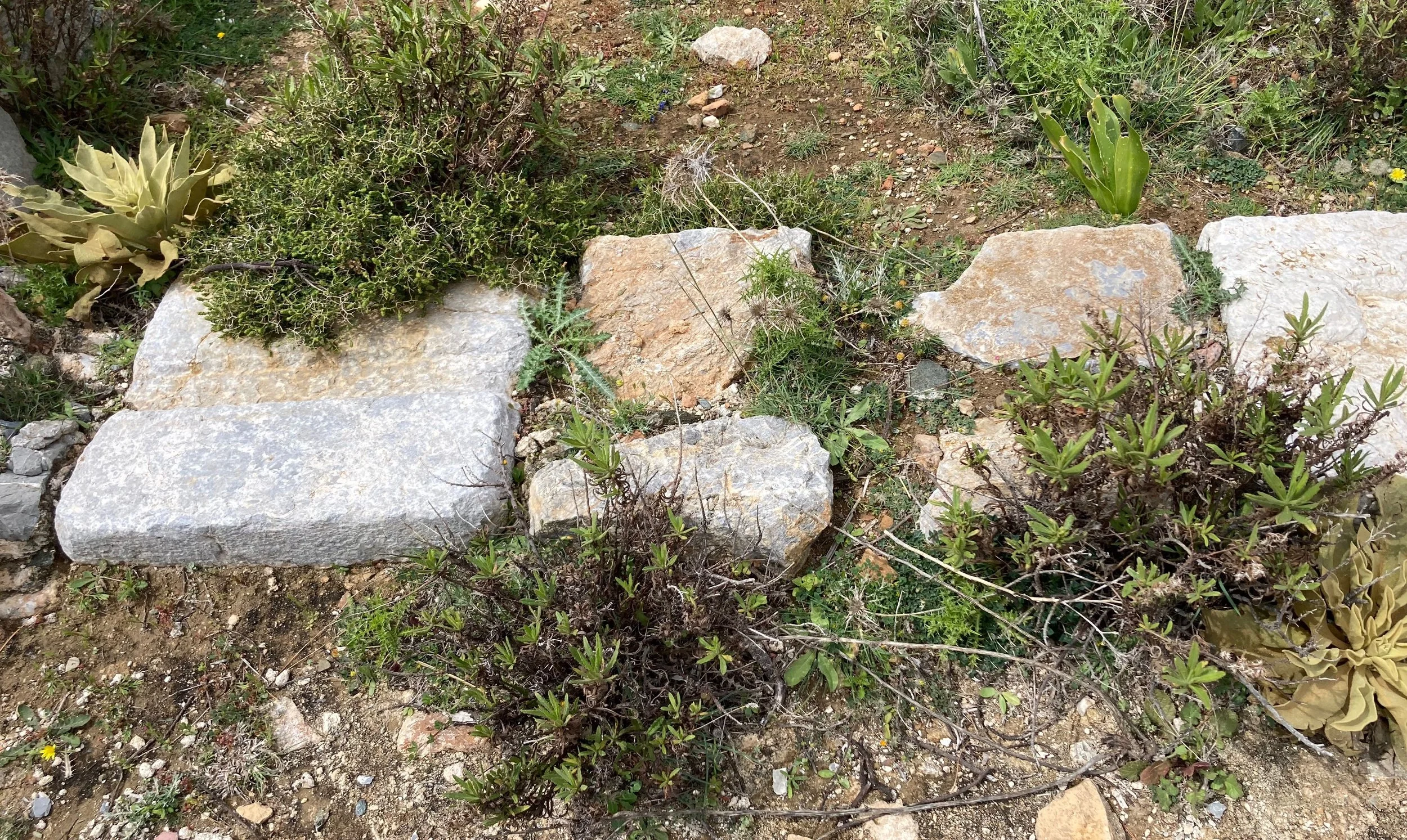
Marble stones and wild herbs in an archaeological site on the isle of Telendos.