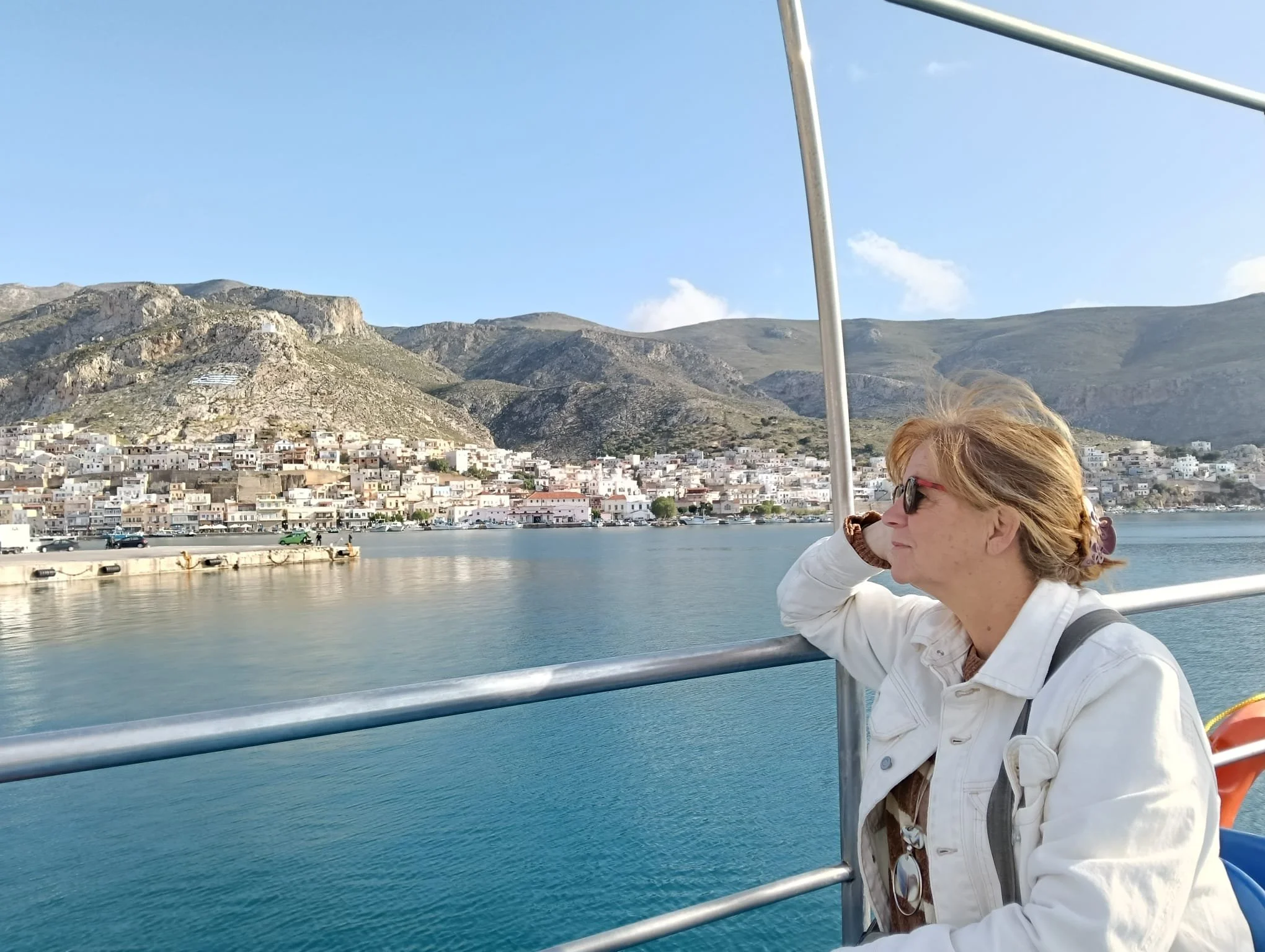
Patricia Anton — Returning to Kalymnos: The journey of translating Charmian Clift
When I first set out to translate Mermaid Singing into Spanish (Cantos de sirena) I had never set foot on the island where the book was born.
I had some old photographs and maps, a handful of online images. I had Charmian Clift’s luminous prose, full of salt and sun and wonder. But I didn’t have the real Kalymnos: not with my own eyes nor my own breath. That came later, much later… more than two years after the book was published in my country. And by then, the act of translation already felt like a dream I’d stepped through: vivid and beautiful, but remote.
So when the writer Nadia Wheatley, Clift’s biographer and greatest authority on her life and her work, told me she was travelling to the island some days prior to a Writer’s Workshop she was going to give there for a group of Australian Clifties, I knew I had to seize the opportunity and travel there as well. Nadia and I had never met in the flesh, but we had emailed each other many times since February 2023 when I first got in touch with her from the island of Hydra, where I was finishing my translation of Peel me a Lotus, to ask her for some advice regarding that second book. When she invited me to speak on Kalymnos about my translation as a little contribution to the workshop, I felt a rush of joy, because I was looking forward to finally meet Nadia in person, but also because I would be able to finally walk the same dusty paths that Charmian Clift had trodden and to look out over the same glittering sea. I would get to see Kalymnos through her eyes. But I must confess I also felt a tremor of doubt.
Would I be able to really see Charmian there?
Would her voice, so vital and complex and beautifully intense on the page, still echo among those steep streets and sunburned hillsides? Would I feel her presence the way I had on Hydra, where I had the chance to travel thanks to a scholarship, while living among the whitewashed houses and faded myths?
And, most of all, would I feel that I had done justice to her work, even though I had never stood on Kalymnos soil while translating her vision of it?
«We came to the island of Kalymnos…»
«Llegamos a la isla de Kálimnos en el Angellico, un pequeño caique gris, rodeando punta Cali con un siroco que arreciaba desde el suroeste…»
Our arrival on Kalymnos was not altogether different from that of Clift’s family so long ago. For us, my partner Rogelio and I, it was late at night, but the wind was blowing hard too and the boat was really lurching along. Instead of ‘the inevitable old dark-shawled women’ we had a group of young rock climbers as travelling companions from Kos.
Kalymnos is not a gentle island. It is bone-dry, rocky, and rugged, carved by wind and sea. But it really glows. Next morning, the wind had died down and we could see, from where we stood at the beautiful terrace of the hotel and under the early golden and pink light, the ochre cliffs rising like old frowning gods. The harbor shimmered with a peace and a tenderness that seemed to slow down time. We were looking at a landscape full of sharp edges that managed also to look surprisingly soft and sweet, and I had a strange feeling, a kind of sense of place that took me in from the first moment. That’s when I began to understand what Charmian had seen in the island.
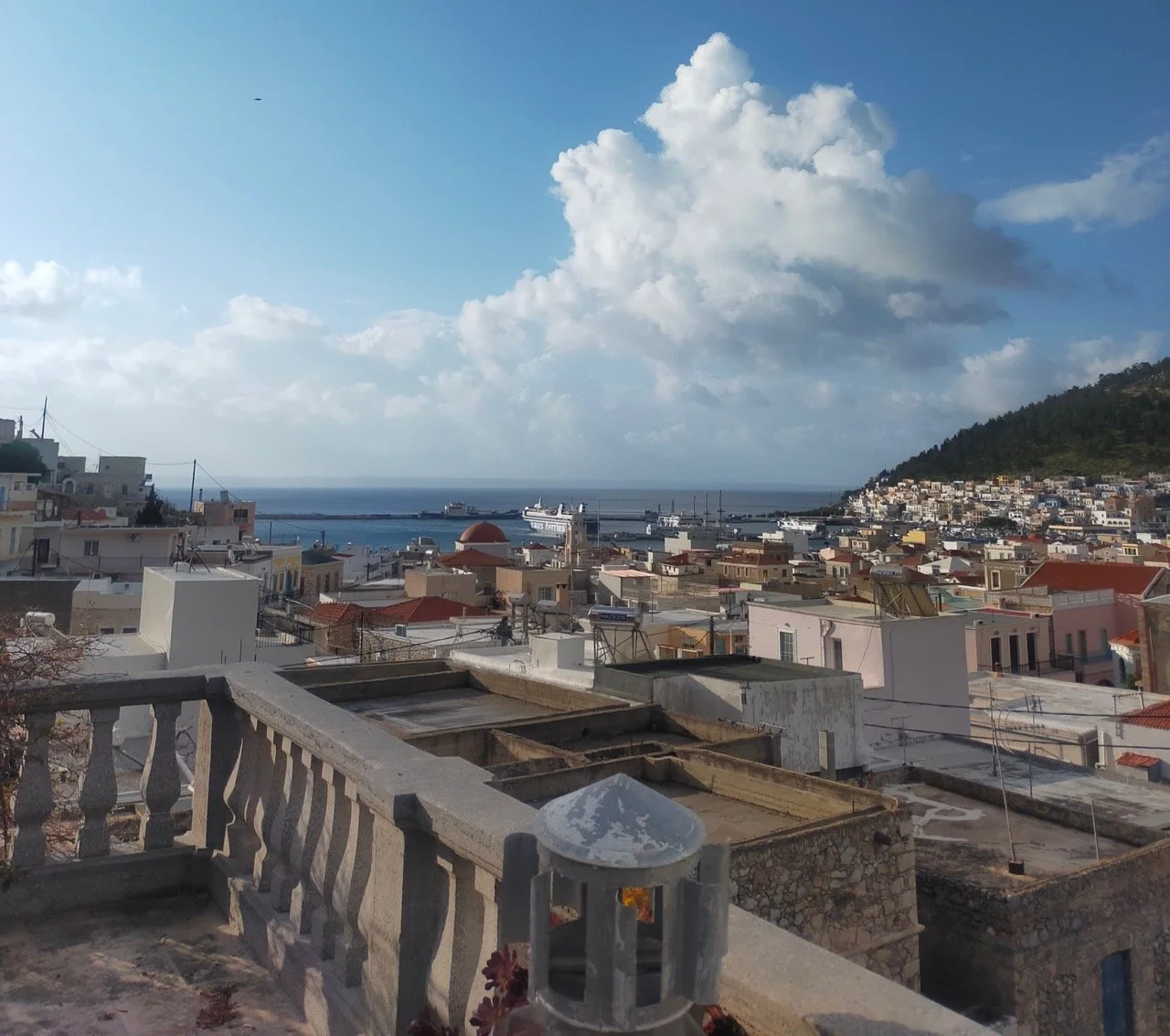
The main town of Kalymnos from the terrace of the Villa Melina
In Mermaid Singing, she describes Kalymnos not as a paradise but as something more intimate and raw. She writes of sponge divers returning from the African coast, gaunt and haunted. She bears witness to the poverty and the pain, but never with aloofness and just pity, never judging. Her gaze is really clear, but her heart is as porous as the sponges kalymnians rip off the seabed.
One image stayed deep down inside me from my first reading of the book and managed to come up again during my visit to the island: Charmian standing at the balcony of her house, looking down at the plaza. Three young men walk slowly across the square, two of them supporting the third. He is broken, maimed during his last dive for sponges just weeks ago. Charmian watches the scene, helpless, with tears streaming down her cheeks. The moment is brief, but the weight of it lingers and gets trapped deep in your soul.
That is Clift at her best: bearing witness, not intervening. Writing with compassion and empathy but never with mere ornament. I remembered struggling to translate that passage: how to carry her quiet grief into Spanish, how to keep her voice steady but aching. And at that moment, standing in a plaza perhaps not so different to the one Charmian was seeing that day long ago, I realized I hadn’t needed to worry. Her words had held.
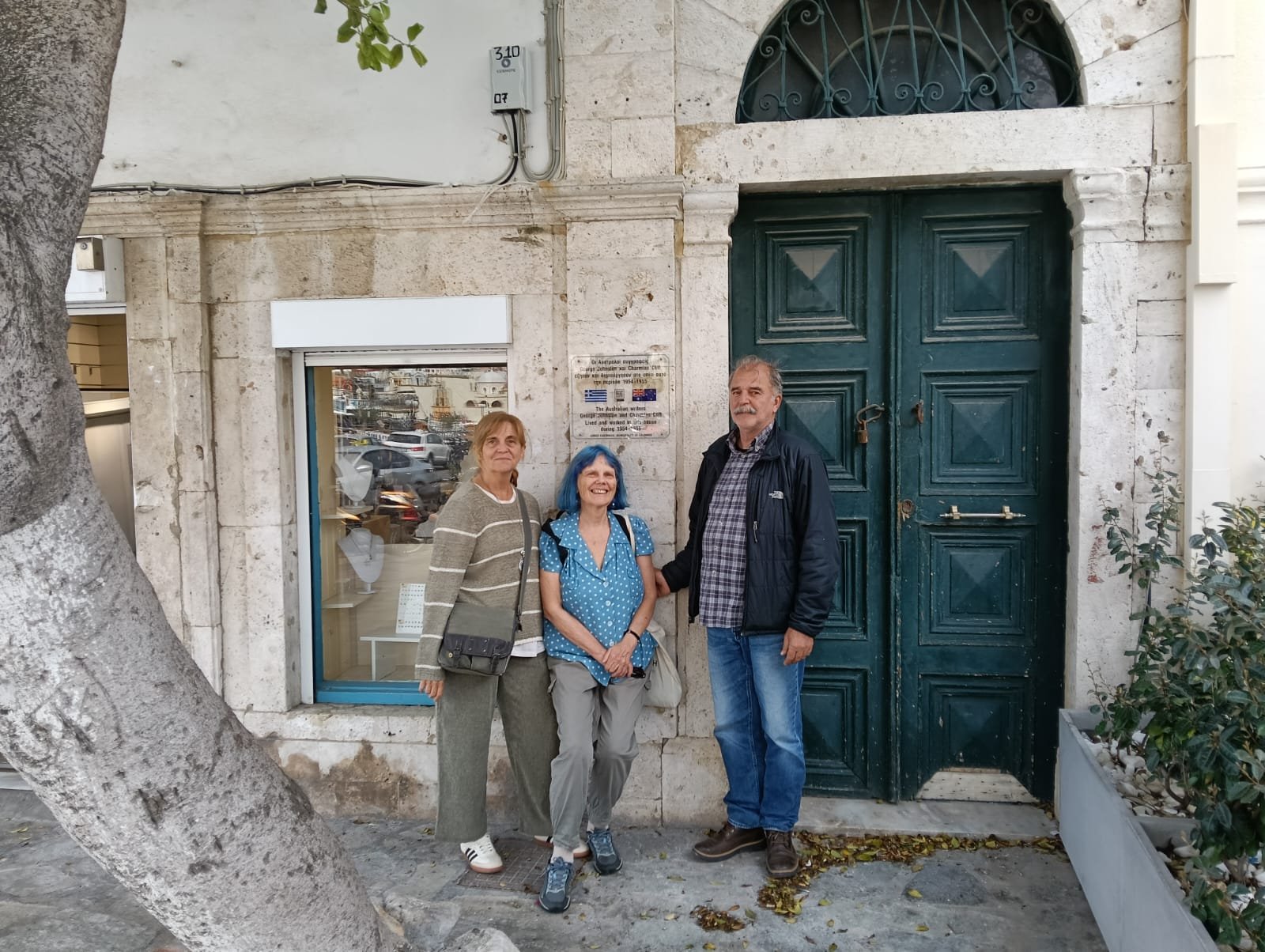
Patricia and Nadia with George Hatzismalis in front of the house where Charmian Clift and George Johnston lived on Kalymnos in 1954-5, now identified with a plaque.
Translating without visiting the place felt, at times, like trespassing. I was venturing into a reality that wasn’t mine, through the language of a woman I would never get to meet. But now, after my visit to Kalymnos, I know that places live in language too. It is not absolutely essential being there in the flesh: if a translator listens closely enough, the landscape, the place, will finally let you hear its voice: its rhythm and its breath and its silences.
Still, being there in Kalymnos seemed to deepen something inside me. I got to meet people who remembered or knew about what Charmian was writing, about the sponge expeditions, the lean years, the waiting women. That people welcomed me with a warmth that mirrored what Charmian once felt: a kind of rough kindness, full of pride and endurance. For me, it felt like their generosity was coming to stitch the gap of the years between us.
After two or three days on the island, another thought began to form in my mind. Quietly at first, then louder.
Did Charmian make a mistake leaving Kalymnos?
Of course, I know she left to follow a dream: she longed for another island, another life, where ‘the lotus grew’. Hydra became her home for nearly a decade, and it gave her much: a third child, a circle of artists and friends, many moments of joy. But I wonder if she ever felt the same closeness and connection there that she found in Kalymnos, that instant sense of being folded into a community, of being one of them.
In Hydra, something in her began to unravel. The silences got heavier as years went by. The page, perhaps, became more distant. She wrote through it with courage and brilliance and sense of humor, but Kalymnos had offered her something more simple and true, something beautifully uncut.
Now, back in Barcelona, I carry a piece of Kalymnos within me. A sense of completion, perhaps, or reconnection. And not just to the book, but to the woman behind it. And maybe that’s what this visit to the island gave me above anything else: the feeling that translation, like travel, is sometimes circular. You begin far from where you need to be. But if you listen long enough —to the wind, to the words— the path will take you there.