The shears … essentially just big tin scissors with two long sharp blades and pointy ends.
The ones Martin and Shane would have seen most days in the hands of the sponge cutters working under their house.
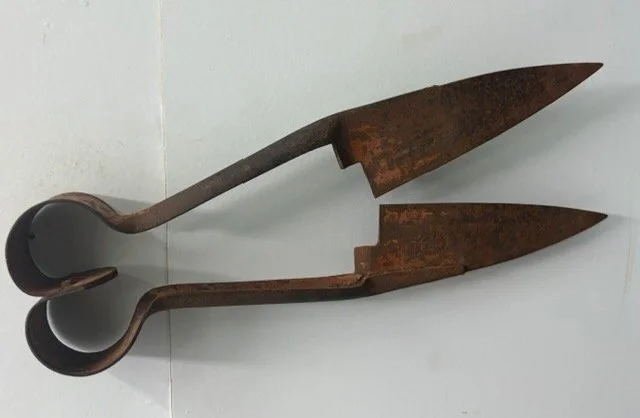
Shears in the Kalymnos Nautical Museum. Photo Helen Wyatt.
Those kids bolting by on their way to or from school, a swim or to meet their mates
And the workers, all men sitting on stools in the semi dark, away from the hot sun, listening for the bells, the people passing, the fights and arguments, donkeys and goats, swearing and laughter, of life outside.
I see the kids, maybe particularly Shane, stopping by to peer in inquisitively. She steps inside, her blonde straggly hair and hard little nut brown body weaving around the men as they work, teasing them about who did the most that day, who's the fastest, the best-ever cutter. She tells them stories from school. From home. England. Australia.
And the men stop a moment or two to listen and laugh and wonder, charmed by the little girl’s confidence and chattiness. These stories from other places.
Places they’ll never see. What do they make of it? Back to their snipping. She’s a reprieve from the monotony or their work.
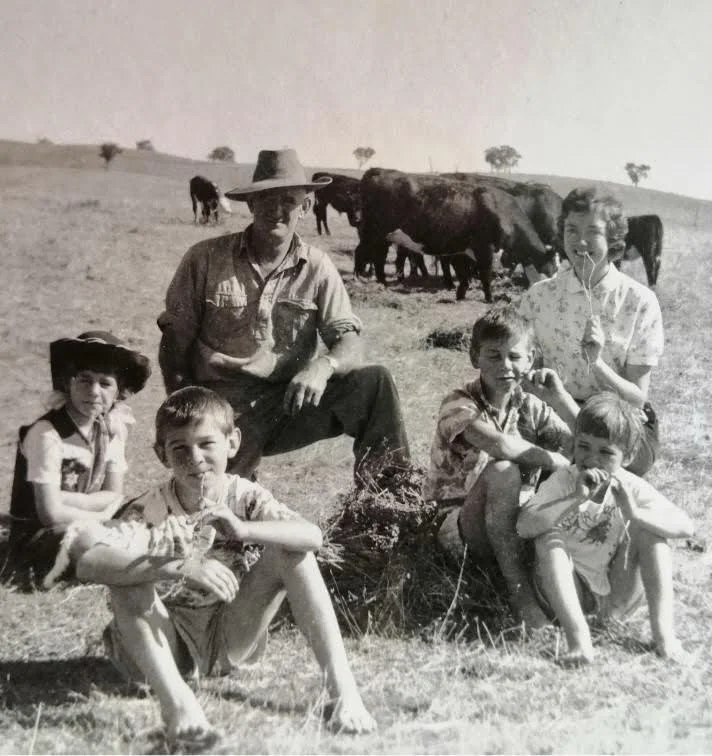
Maureen at left, with her father and some of her nine siblings, on the farm in north-east Victoria, 1950s.
On the farm where I grew up, the shearing was motorised but … not the crutching. That was done by hand with shears exactly the same as used by the sponge cutters.
In the summer the sheep often got flyblown and so Dad would herd them up, paddock by paddock, into the yards, and go through them.
'‘Here’s one!’ The big round dags around her rear end would be the giveaway. Either grey and dry or wet and gruesome-green to my eyes then.
‘Get me the shears Maureen! And that plastic bottle over there!’
The orders was always harsh and sharp. This, after all was men’s work. No mucking around or looking up to dream at the huge sky. I was there to fetch and carry.
With the help of the dog he’d grab the ewe’s back leg and quickly turn her over onto her haunches, holding her between his legs. She’d be bucking, kicking with fear. Then he’d begin to slice off the dags with those big shears. Roughly first and then as he got closer to her skin more slowly. Carefully. The aim was not to cut her. A cut would bring more flies. More often than not there would be maggots already burrowing into her flesh. Horrible tiny white grubs.
‘Ah hell. Let’s clean her up,’ he’d say. And with the edge of the shears he’d almost delicately begin to scrape round her bottom, all the infested delicate parts and the maggots would fall off in their hundreds.
The strong sanitising solution would be tipped over the whole area. He’d stand then, push her off and watch her go, always a with a nod of satisfaction.
One down. Now for the next one.
Sponge cutters in Kalymnos and farmers in Australia don’t have much in common. But men’s work is serious business.
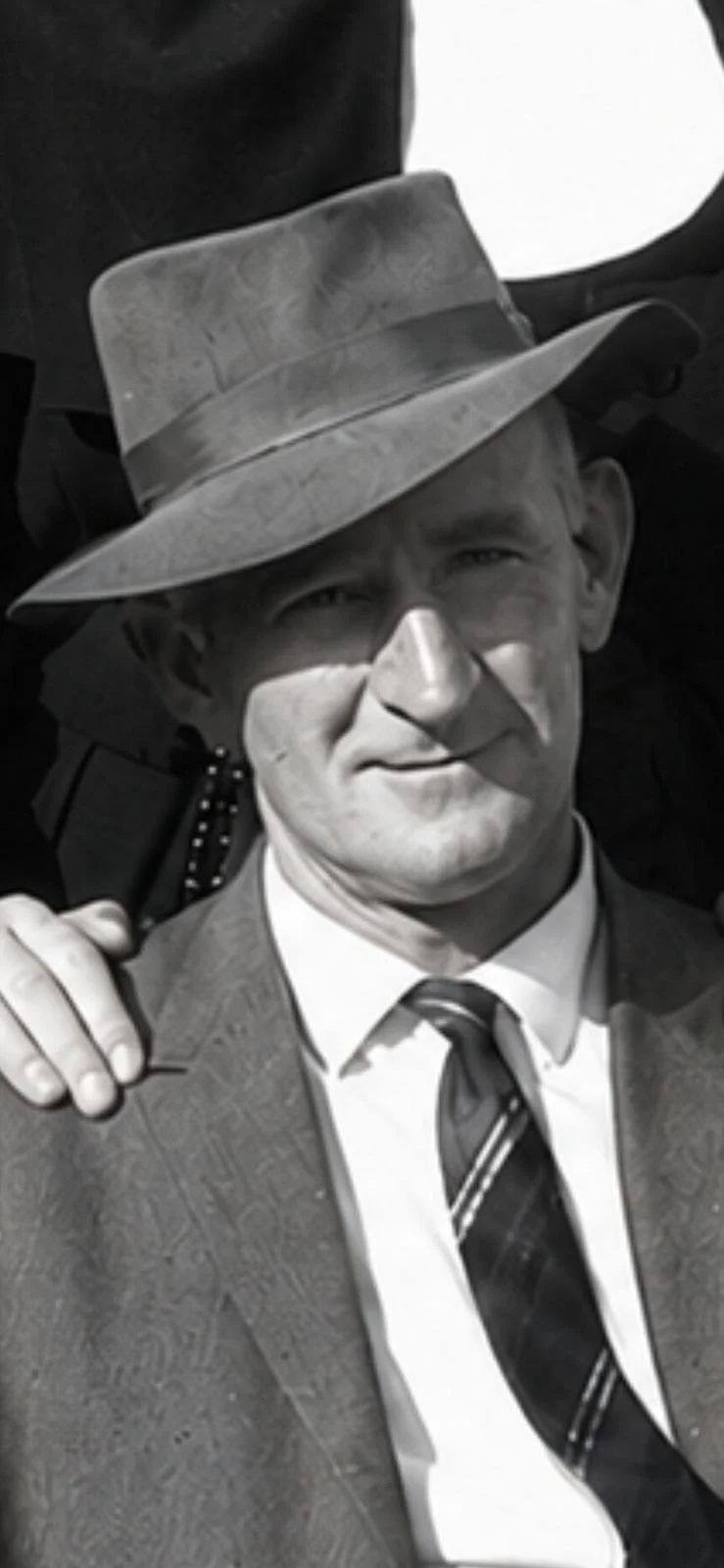
Maureen’s father. What an Irish/Australian country face!